7 Declare Your Research Question
This chapter is part of a book in active development and has not yet been through the author’s review. Content may change as the review advances.

The research decision. Turn your classified lead question into the formal declaration that will govern the project: the question sentence plus its field card, with the claim boundary attached. AI may draft candidate wordings under your rules; every word that survives is one your name signs.
7.1 Why this decision matters
The decision on the table: which exact words, out of every way your question could be phrased, become the sentence the whole project answers to.
This is where the studio’s two purposes meet. You spent the last lessons building rules: a ledger, a delegation map, a verified exchange, an ownership statement. Those rules were never the point; they exist so that THIS decision can be made well. The declaration is the first artifact your rules govern end to end, and it is the highest-stakes sentence of the project so far, because every later choice — which evidence belongs, which analysis runs, which claim ships — checks itself against these words.
Words do real work here. Change “dinner entrees” to “what a student pays for dinner” and you have changed which rows of the world your project counts. Change “went together” to “raised” and you have promised a comparison your design may never pay for. A declaration is not prose polish. It is the project’s contract with the evidence, written while changing it still costs nothing.
7.2 The concept
The declaration has two parts, and neither substitutes for the other.
The first is the lead question: the single sentence, classified by kind and reach in the last lesson, that your evidence will answer. The second is the field card: the short record that pins down every term the sentence carries (Booth et al. 2024). A field card names the objective (what the study intends to describe, predict, or explain), the unit of analysis (the kind of entity the answer makes a claim about), the outcome (what you will actually record), the conditions (the comparison, setting, or time that gives the outcome meaning), the question’s kind and reach (from the compass), and the provisional claim boundary: the sentence you hope to defend, and the stronger sentence you already know you will not be able to.
Do not force every field into one overloaded sentence. A readable question plus a complete card beats a sixty-word question every time. And write the boundary now, not after the results: a boundary written early is a promise; a boundary written late is an excuse.
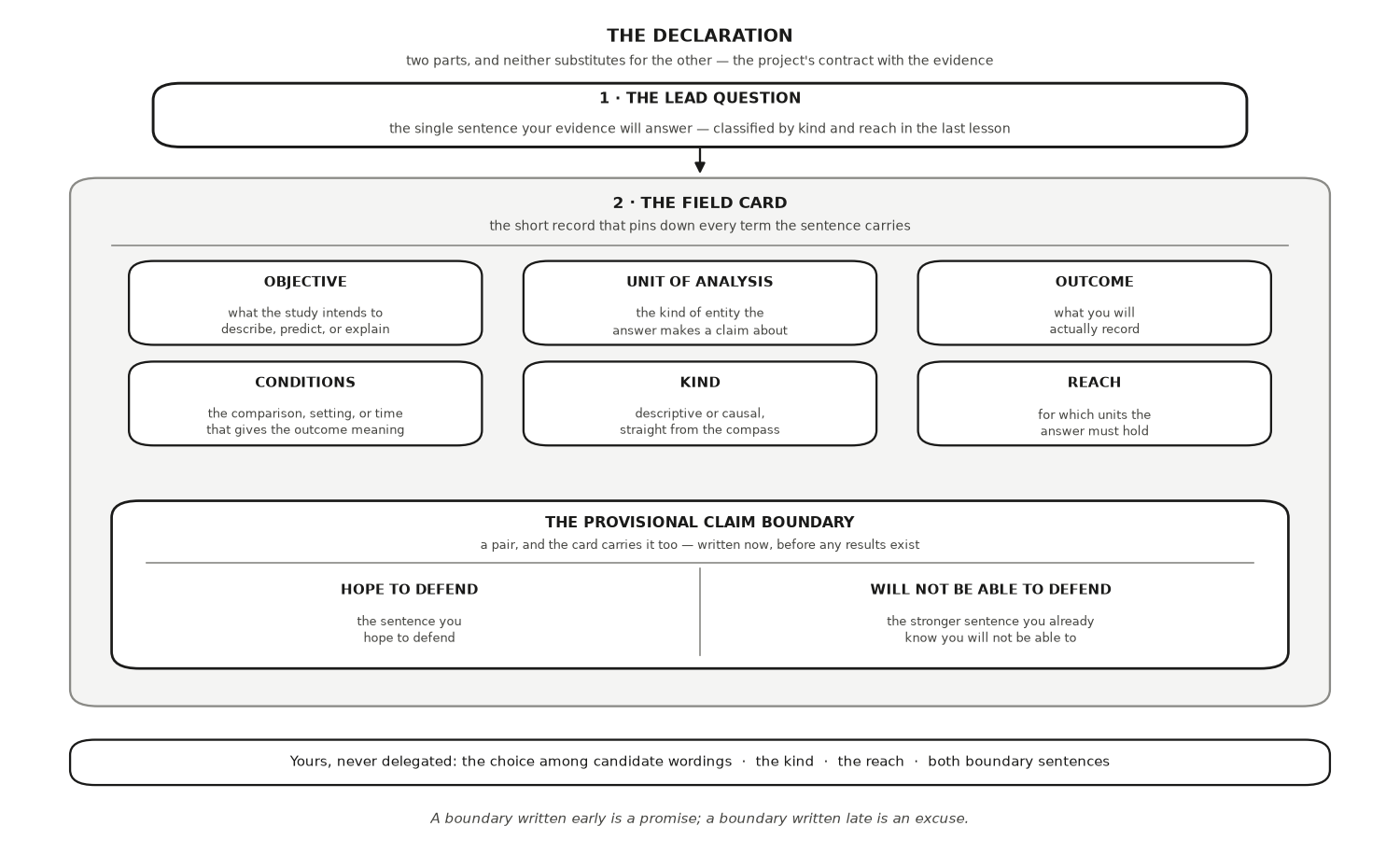
Declaring is also a delegation exercise, and that is the point of doing it in this studio. Candidate wording is the one part of the declaration that delegates well: an AI tool can produce five phrasings of your question in seconds, and some will be sharper than yours. What never delegates is the choice among them, the kind, the reach, and the boundary, because those decide what the project promises. The discipline that makes the delegation safe is show-what-changed: for every candidate wording, the tool states exactly which words differ from yours and what each change does to the question’s meaning. A wording whose changes you cannot account for is not a sharper question. It is a different one.
7.3 A worked example
The restaurant-prices reader arrives with a classified lead question: “did menu prices near campus rise faster than overall prices between 2019 and 2025?” Descriptive kind, data-at-hand reach. Now the declaration.
Watch what the wording decides. The block below builds a tiny menu world and asks the question two ways against the same overall-price benchmark. Wording A pins the outcome to listed dinner-entree prices. Wording B counts the listed price plus its delivery fee, across every item type. Same world, two questions, two different answers:
import numpy as np, pandas as pd
SEED = 464
rng = np.random.default_rng(SEED)

n = 200
items = pd.DataFrame({
    "year": rng.choice([2019, 2025], size=n),
    "kind": rng.choice(["entree", "drink", "side"], size=n, p=[.5, .3, .2]),
})
base = np.where(items["kind"] == "entree", 13.0,
        np.where(items["kind"] == "drink", 3.5, 5.0))
growth = np.where(items["year"] == 2025, 1.24, 1.0)   # prices grew ~24%
items["price"] = np.round(base * growth * rng.normal(1, .08, n), 2)
# delivery fees barely existed in 2019 and are common in 2025
items["fee"] = np.where(items["year"] == 2025,
                        rng.choice([0, 2.5, 4.0], size=n, p=[.3, .4, .3]),
                        rng.choice([0, 2.5], size=n, p=[.9, .1]))

def growth_pct(df, col):
    m = df.groupby("year")[col].mean()
    return 100 * (m[2025] / m[2019] - 1)

# The overall index is an INPUT you retrieve from the agency's table
# (Lesson 2's discipline); this stand-in says overall prices rose 18%.
overall_index_growth = 18.0

a = items[items["kind"] == "entree"].copy()
wording_a = growth_pct(a, "price")
items["paid"] = items["price"] + items["fee"]
wording_b = growth_pct(items, "paid")
print(f"overall index (retrieved input)          : {overall_index_growth:5.1f}% growth")
print(f"Wording A — listed dinner-entree prices  : {wording_a:5.1f}% growth")
print(f"Wording B — listed price plus fee, all   : {wording_b:5.1f}% growth")
print(f"\nA beats the index by {wording_a - overall_index_growth:.1f} points; "
      f"B beats it by {wording_b - overall_index_growth:.1f}.")
print("same world, two sentences, two answers: the sentence chooses the rows")
Fixing the outcome and the units before any analysis is the standard craft of question formulation, and it is what keeps the two wordings from blurring into one claim later (Booth et al. 2024).
The reader picks wording A, and the field card records why: objective, describe menu-price growth against the overall index; unit, a menu item retrievable in both years; outcome, the listed price; conditions, 2019 versus 2025; kind, descriptive; reach, the data at hand. The comparison in the sentence is now visible in the code: both wordings outran the retrieved index in this world, by different margins. The boundary pair: hope to defend, “on this panel, listed prices rose faster than the index”; will not defend, “eating near campus became less affordable,” because fees, portions, and wages are outside these words. Wording B is not wrong. It is a different project, and the card is what keeps the two from blurring later.
7.4 An AI failure case
You paste your lead question and ask a tool to “make it more precise.” It returns: “did rising restaurant prices reduce students’ dining-out frequency near campus between 2019 and 2025?” It reads sharper. It is a different study. The subject slid from prices to student behavior, the outcome from a listed price to a frequency nobody measured, and the kind from descriptive to causal, all in one helpful-sounding sentence.
You catch it with show-what-changed: put the tool’s sentence beside yours and account for every word that differs. Three of the changes have no reason you can write down, so the wording is rejected, and the rejection goes in the ledger. The failure is silent scope change at the declaration level, and it is the most expensive version of it, because a drifted declaration drifts everything downstream.
7.5 It is your turn
You are working inside Studio 2: Set your rules, shape your question. Keep what you write here; the studio’s milestone chapter is where it joins the other lessons’ pieces into one artifact you can defend.
You arrive with a classified lead question and a working agreement. This practice closes the studio: the declaration, written under your rules, with every surviving word yours.
The hands-on half of this section lives in the chapter’s companion notebook: open it in Colab with the badge at the top, and work the steps there.
Commit your own answer first, then delegate. The declaration is the first artifact your rules govern end to end; treat it that way.
The choice among candidate wordings. The question’s kind and reach. Both boundary sentences. The tool drafts phrasings and flags weaknesses; deciding what the project promises is the researcher’s job.
Write your field card first, from your own lead question as it stands: objective, unit of analysis, outcome, conditions, kind, reach. One line each.
Delegate the wording, under show-what-changed:
Candidate wordings (you choose; the tool accounts for itself).
Here is my research question: [your sentence]. Here is its field card:
[paste your six one-line fields]. Draft five candidate wordings that
keep the sentence and the card in agreement: units, outcome,
conditions, kind, and reach exactly as the card states them. For each
candidate, list every word that differs from my sentence, say what the
change does to the question's meaning, and check it against the card.
Do not add topics, populations, or outcomes I did not name, and do not
change what kind of question it is.
After running, verify: account for every changed word yourself, and reject any candidate whose changes you cannot explain in one sentence. This counters silent scope change, where a sharper-sounding sentence is quietly a different study. Log the exchange, kept and rejected, in your AI Research Ledger.
Choose the final wording and write one sentence on why it beat the others, including yours if yours lost.
Write the boundary pair: the sentence you hope to defend, and the stronger sentence you will not be able to defend, each in one line.
Write the declaration’s uncertainty-and-limitations line: the key limitation you already foresee in answering these words with the evidence you can reach, and the uncertainty any answer will have to carry. It travels with the question from day one; a declaration without it is not complete.
Run the stranger test on the declaration: hand the question and the card to someone who knows nothing about the project, and ask them to say what one unit is, what gets recorded, and who the answer is about. Where they stall, revise before you version.
Log the declaration in your AI Research Ledger and date it: this is version zero of the sentence your whole project answers to, and the milestone files it beside your working agreement.
A declared question is a commitment, not a shield against evidence. The next studio holds it up against what other researchers already know.
Milestone next. This was the last lesson of Studio 2. Milestone 2: Your rules and your question is where the lessons’ pieces become the studio’s versioned artifact. Produce it before you move on.