How this book is organized
This chapter is part of a book in active development and has not yet been through the author’s review. Content may change as the review advances.
This book is built as twelve studios. A studio is a stretch of real research work with a product at the end: an artifact you make, date, and version, from your first working agreement to the release decision on a finished project. Each studio opens with a page that names its milestone and why it matters, then hands you its lessons — short readings that each settle one research decision and end with an It is your turn section — and closes with a milestone chapter where those pieces become the studio’s artifact. Read, do, conclude. The twelve milestones chain, each handing the next its material, until the last one closes on the release decision for your finished research artifact. By the last studio you have not read about a research project; you have one.
The road starts with you, not with a tool. Studio 1 is your curiosity’s studio: it opens with a human-only move — one thing you genuinely want to understand, written down before any tool is open — shows why that jump is the one move AI cannot make for you, then stretches it, tools welcome, into your chosen research problem. Studio 2 protects it: the operating rules (AI is your arm and your research assistant, not your brain), your role (research director), the protocol you run every time you delegate (SDIIVDD), the ownership that never transfers, and, with the rules standing, the formal declaration of your research question.
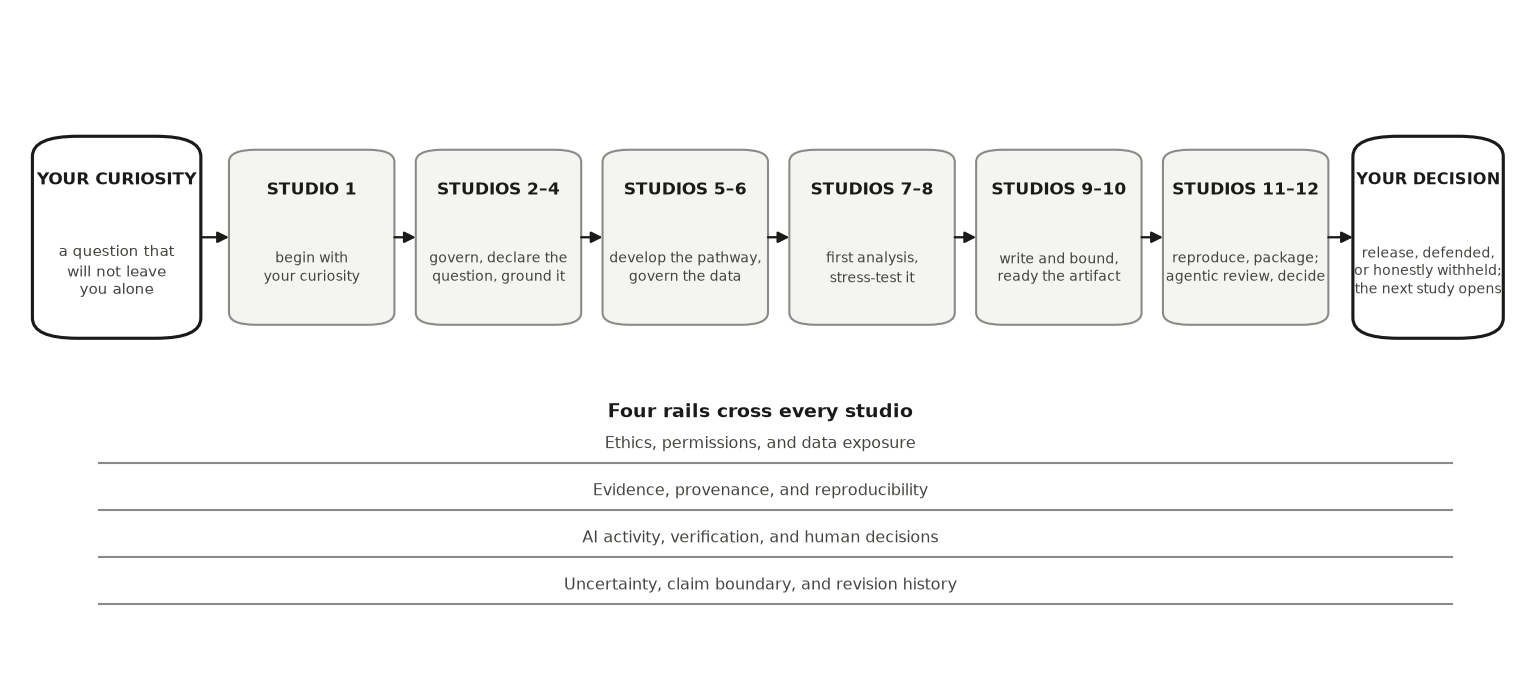
The road has a shape worth naming. Studios 2–4 set your rules, declare your question, and turn it into a declared, diagnosable research design. Studios 5–6 develop your pathway — observational or experimental, descriptive, causal, or predictive — and put your data and measurement under governance. Studios 7–8 produce your first reproducible analysis and then try to break it. Studios 9–10 write your claims down with their boundaries and turn them into an artifact ready for its outlet or event: a paper, a seminar, a talk, or a poster. Studios 11–12 make the work reproducible by strangers, then close on the book’s special topic: directing agentic AI through the final review and the release decision. Six arcs, twelve studios, one project.
Choose your path
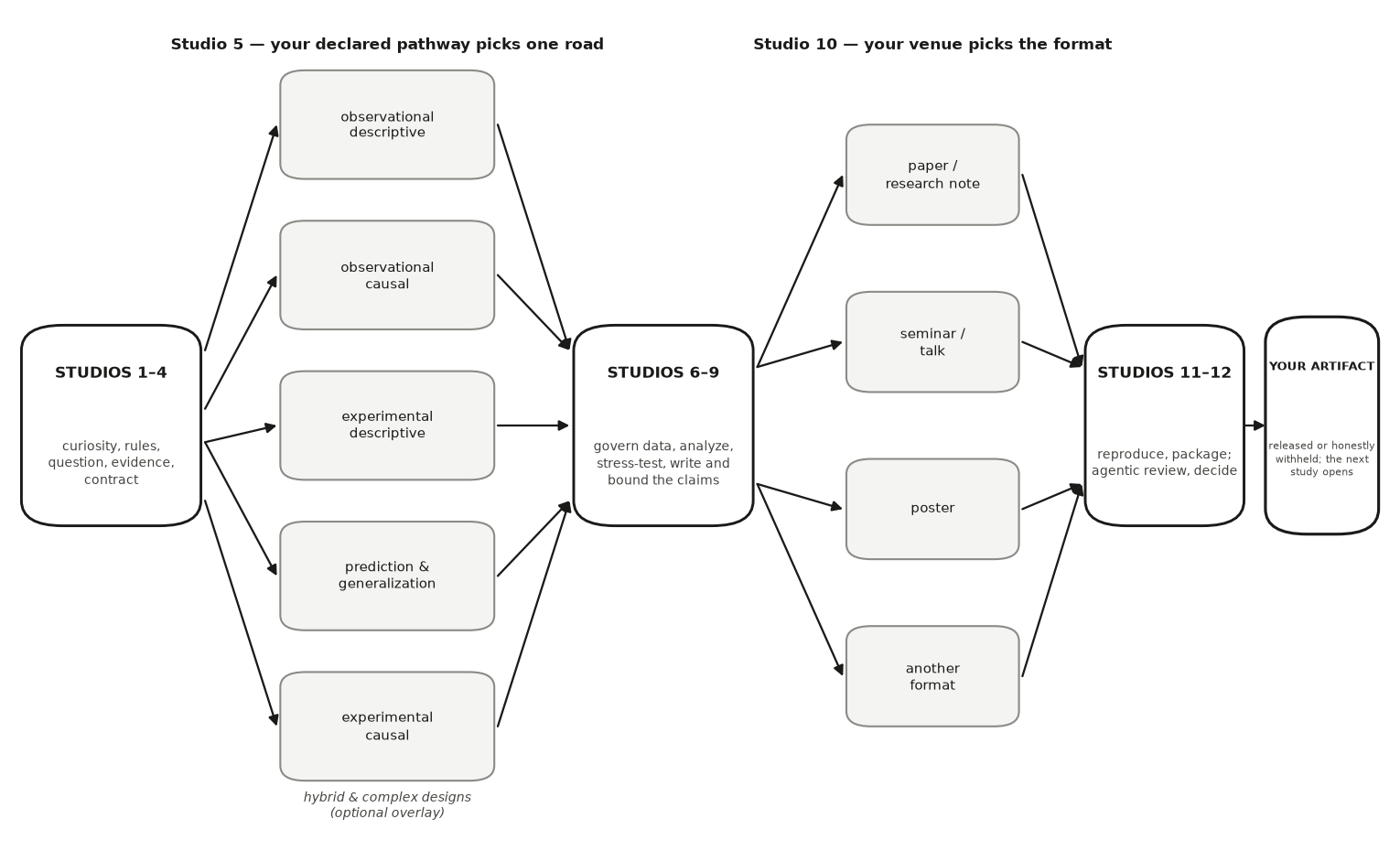
Every reader walks the same spine, and no two projects walk the same road. Studios 1–4 are common ground: your curiosity, your rules, your declared question, your verified evidence base, your contract. At Studio 5 your declared pathway picks one of five branch lessons — work yours, read one contrast, and take the complex-designs overlay only when your design has stages. Everyone rejoins for Studios 6–9: governed data, a first reproducible analysis, the stress test, and claims written at the strength the audit licenses. At Studio 10 your venue picks the format: a paper or research note, a seminar or talk, a poster, or another form entirely. And everyone closes the same way, through the reproducible package and the release decision. Five pathways in, four formats out: twenty end-to-end roads, one spine, one artifact with your name on it.
Beyond the five pathways, the Further Research Routes section after Studio 12 holds six more routes that extend them: natural experiments, survey experiments, audit studies, text as data, qualitative inquiry, and evidence synthesis. Some designs ask for more than this book can teach, such as instrumental variables or synthetic control. The appendix Further Designs: A Field Guide says what each one answers, what it demands, and where to learn it with a mentor.
Two more things, so the structure never surprises you. First, not every lesson is for every reader at every moment: pathway lessons serve the pathway you declared, and an occasional lesson is an optional overlay — each one says so at its It is your turn section, and skimming what does not serve your project is using the book correctly. Second, every studio’s milestone artifact is a dated, numbered version, not a box you tick: when later evidence changes your mind, you write the next version and say why. That record of changes is part of the research, not an admission of failure.