EDR|AI — Evidence-Driven Research in the Age of AI
How to Design, Analyze, Verify, and Defend
Preface
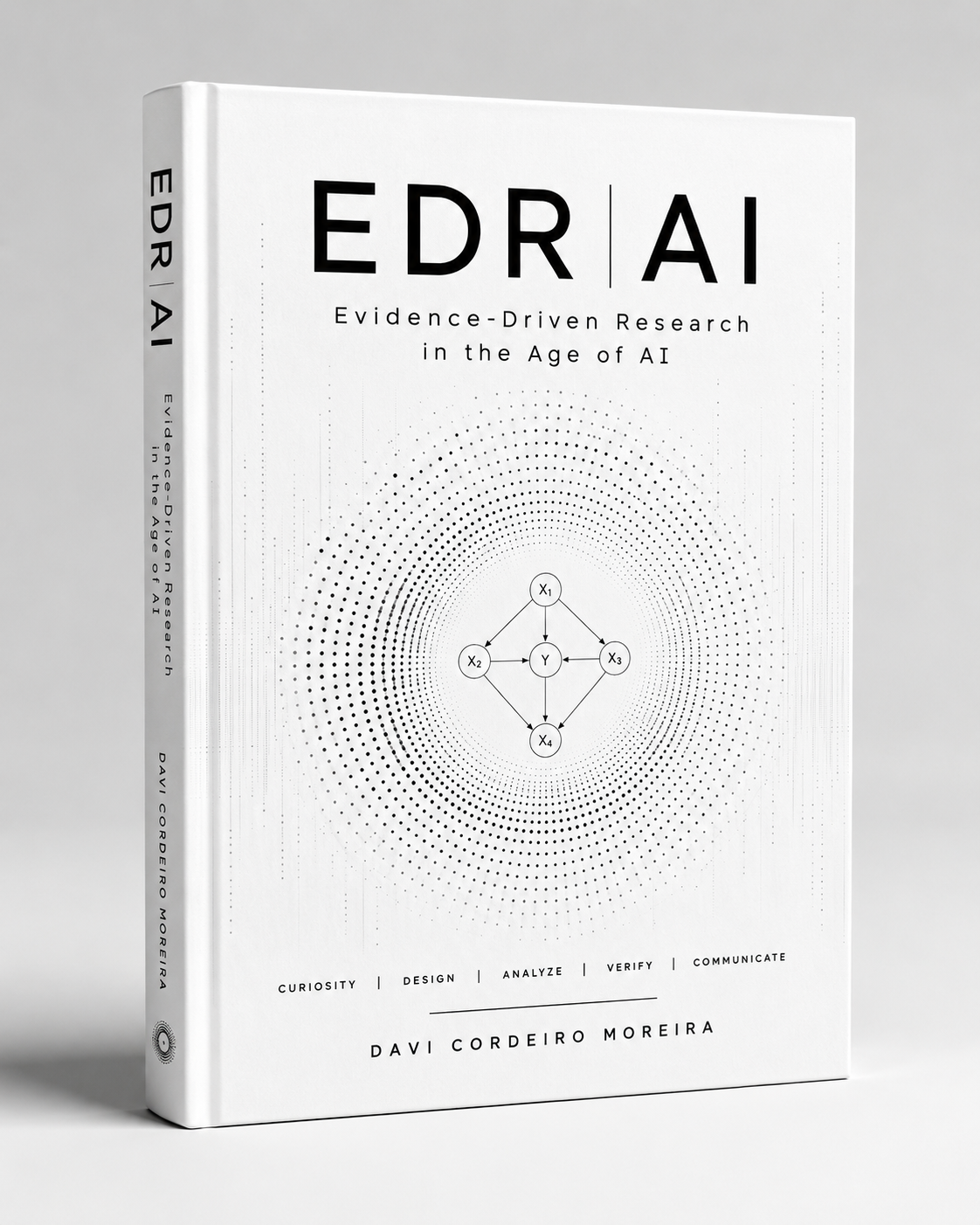
This book is a work in progress. It is still under development and will keep growing and improving over time. Chapters may be revised, expanded, or reorganized as it is used in the classroom; when something looks unfinished, that is why. Questions and suggestions are welcome.
EDR|AI — Evidence-Driven Research in the Age of AI: How to Design, Analyze, Verify, and Defend — is an open research manual for undergraduate students who want to produce research they can defend. It starts where research starts: with something you genuinely want to understand, and with what would count as evidence for an answer. AI can now draft the code, the prose, the citations, and the figures, and this book will put all of that drafting power in your hands. What AI cannot do is decide what your question is, what counts as evidence for it, or whether a claim deserves your name. This book teaches those decisions first, and keeps them yours to the last page. It was first written for an Honors research seminar at Purdue University, and it is deliberately institution-agnostic: any instructor or student, anywhere, is welcome to adopt it.
Its one message: AI is your arm and your research assistant, not your brain. You will direct AI tools through the Specify → Delegate → Interrogate → Inspect → Verify → Document → Defend workflow while keeping every research decision your own. AI here means the full range of today’s tools, from chat assistants to agents that carry out multi-step work on their own; whichever you use, you review, you curate, and you decide. One rule runs through every verification step, collected in the Verification Guide appendix: AI can review AI, and a second model is a real auditor of the first, but the last decision is always human.
The book is built as twelve studios — begin with your curiosity, govern the work and declare your question, ground it in evidence, declare and diagnose, develop the pathway, and so on to the release decision on a finished project. Each studio opens by naming the milestone ahead and why it matters, hands you its lessons, and closes with a milestone chapter where you produce a dated, versioned record of the studio’s artifact. The page How this book is organized draws the whole road. After the twelve studios, the Further Research Routes section holds six more routes a question can call for: natural experiments, survey experiments, audit studies, text as data, qualitative inquiry, and evidence synthesis. A last appendix, Further Designs: A Field Guide, describes the designs that are best learned with a mentor. EDR|AI draws its design framework from Blair, Coppock and Humphreys’ Research Design in the Social Sciences (RDSS, free at book.declaredesign.org), especially its MIDA framework and its declare, diagnose, redesign cycle, adapted here for a first empirical project, most often a quantitative one, and joined to a governed AI workflow. It is a companion and an operational on-ramp to RDSS, not a translation or a substitute (the repository’s coverage matrix records what is adopted, adapted, and omitted); read the matching RDSS chapters whenever you want more depth.
Why this book
This book comes from a particular seat. At Purdue’s Daniels School of Business I direct the undergraduate honors program, serve as the school’s undergraduate research representative, and this fall help launch its new honors scholarship. My training is in evidence: political communication, text as data, and applied data science, with years of program-evaluation fieldwork for the World Bank. Much of my career has gone into teaching material for students at every level, from txt4cs, an open text-as-data tutorial, to published work on pedagogy. More recently I have used AI tools and agents to design, redesign, and produce entire courses and their materials — a full predictive-analytics course among them — alongside research on AI-assisted course development.
From that seat the gap was easy to see. Undergraduates now meet AI before they meet research method, and someone has to show them what the method is for when the tools can draft everything. EDR|AI is my answer: an invitation to share what I know, and a push toward research you can defend in an era that will hand you almost everything else.
For students
Every chapter does the same work in the same order: it names a research decision, works an example, shows an AI failure and how to catch it, and hands the work back to you. The hands-on half lives in the chapter’s companion Colab notebook, opened by the badge at the top of the chapter. Run the chapter’s code there, work the AI prompts, and complete the closing It is your turn section without leaving the browser.
The book has two grains, and the table of contents holds them in one spine.
Studios are what you do. There are twelve, and they ARE the book’s parts. Each studio opens with the milestone you are heading toward, and closes with a milestone chapter: you conclude it by producing a dated, numbered version of the studio’s artifact rather than ticking a box. When later evidence changes your mind, you write the next version and say why. That record of changes is part of the research, not an admission of failure. The twelve milestones chain, each handing the next its material, and the last one closes into your finished research artifact.
Lessons are what you read, inside each studio. Each one takes a single research decision, works an example, and ends with an It is your turn section that applies it to your own project. What you write there is a piece of the studio’s milestone, and the milestone chapter names it on its checklist.
The practical rhythm is baked into the page order: read the studio’s opener, work through its lessons doing each It is your turn, then conclude the milestone chapter that closes the studio. If you are studying on your own, the studios, the lessons, the companion notebooks, and the Verification Guide are the whole path, at your own pace. Bring the curiosity; the book supplies the discipline.
What you need before you start
A way to run Python. Every companion notebook opens in Google Colab from the badge at the top of its page, which needs a free Google account and nothing installed. If you would rather work locally, any Python setup with numpy, pandas, and matplotlib runs the same code.
An AI assistant. The book asks you to delegate work to one and then verify what comes back. Any general assistant with a free tier will do, and so will one your institution provides. If you have no access to one at all, every AI prompt in this book still works as a thinking exercise: write the answer you would expect first, which is what the book asks you to do anyway, then treat the prompt as a checklist of what a good answer would have to contain. You lose the practice of interrogating a tool; you lose none of the research method.
A place to keep your work. One folder, backed up. Studio 1 makes you decide where.
What you do not need: a course, an instructor, a subscription, or institutional database access. Where the book asks for something you cannot get on your own — a research-ethics authority, a peer reviewer, restricted data — it says so and gives you the solo route.
Two things in this book genuinely require other people. Human-subjects research needs a competent authority to rule on it, and no book can stand in for that; if you have no institutional affiliation, take the public-data or simulation route the ethics lesson describes, which reaches the same methods without collecting data from people. And some checks call for a reader who is not you; where that matters, the book names a solo substitute rather than pretending an AI can be your peer.
For instructors
EDR|AI grew out of a semester-long undergraduate seminar, and the appendix For instructors makes that course available: the classroom lab notebooks, the milestone chain that carries the chapters’ “It is your turn” sections into a final research artifact, the grading rubrics for those sections, and the class format in which every lecture opens with a ten-minute lab meeting, where the instructor asks the room how the projects are going and the room answers, with nobody assigned and nothing prepared. Questions are welcome by email; the address is on the About the Author page.
Languages
EDR|AI is also available in Português (Brasil) and Español; the language buttons at the top of any page switch editions in place. The English edition is the source of truth, and the translations are regenerated from it as it evolves.
To meet the person behind the book, turn the page: About the Author comes right after this preface.