HONR 46400 · Evidence-Driven Research
Studio 9 — Write, bound, and disclose
What you can defend when you leave
Studio 9
Write the claim you can defend, bounded by what your evidence supports, with your AI use disclosed.
The milestone ahead
Studio 9
This studio closes with Milestone 9: Your bounded claims, a short chapter of its own after the lessons. What it asks you to produce. A stand-alone research note or report draft, a claim-to-evidence table, and your AI disclosure statement.
The lessons in this studio
Studio 9 · Road map
- Lesson 28 — From Results to Claims: your claims with verbs downgraded to what the design established, each carrying its boundary line.
- Lesson 29 — Claim–Evidence Tables: your claim-evidence table, one row per claim with claim, evidence, trace, and boundary, every number traced to its output.
- Lesson 30 — AI Disclosure and Research Integrity: your AI-use disclosure, written from the ledger and naming what you did not verify.
- Lesson 31 — From Dossier to Research Note: your stand-alone note draft: the problem-gap-question spine, methods, results with uncertainty, discussion, ordered findings with the headline claim’s boundary inside, references, your disclosure placed, and the pointer to the package Studio 11 will freeze.
From Results to Claims
Lesson 1 of this studio · Chapter 28
the verb in your headline, and how far your evidence lets it reach
The research decision
Chapter 28
Your analysis printed a number. Now you decide the sentence that number lets you assert: the headline you will show in public and defend out loud, worded so its verb stays inside what your design established and its uncertainty rides in the same eye-span. You choose the words. You lock them. You never let a tool talk your claim past its boundary.
The words this chapter uses
Chapter 28 · Key terms
Uncertainty in the same eye-span
the interval or caveat sits right beside the claim, not in a footnote (Wasserstein & Lazar 2016).
Traceability
every number you show walks back to the exact notebook cell that produced it.
A claim that outruns its evidence makes a judge distrust the whole board
Chapter 28 · Why this decision matters
- That is a research-integrity judge, working a poster session.
- She is not testing your statistics.
- She is testing whether your words match the evidence underneath them.
If the headline reads ‘lowers blood pressure’ but the study only watched who chose to walk, I stop reading.
Your analysis prints a number; your headline asserts a sentence
Chapter 28 · Why this decision matters
- A result is not yet a claim.
- The gap between the two is where most projects break.
- The sentence almost always wants to say more than the number earned.
- Close that gap yourself, before a stranger finds it open.
A result is a number; a claim is a sentence you will defend
Chapter 28 · The concept
Result
a number your analysis produced, such as a difference of 6 points between two group averages
Claim
a sentence you assert and will defend, such as ‘the walking group had lower blood pressure’
- Turning the first into the second is a decision, not a formatting step.
- You choose how much the sentence is allowed to say.
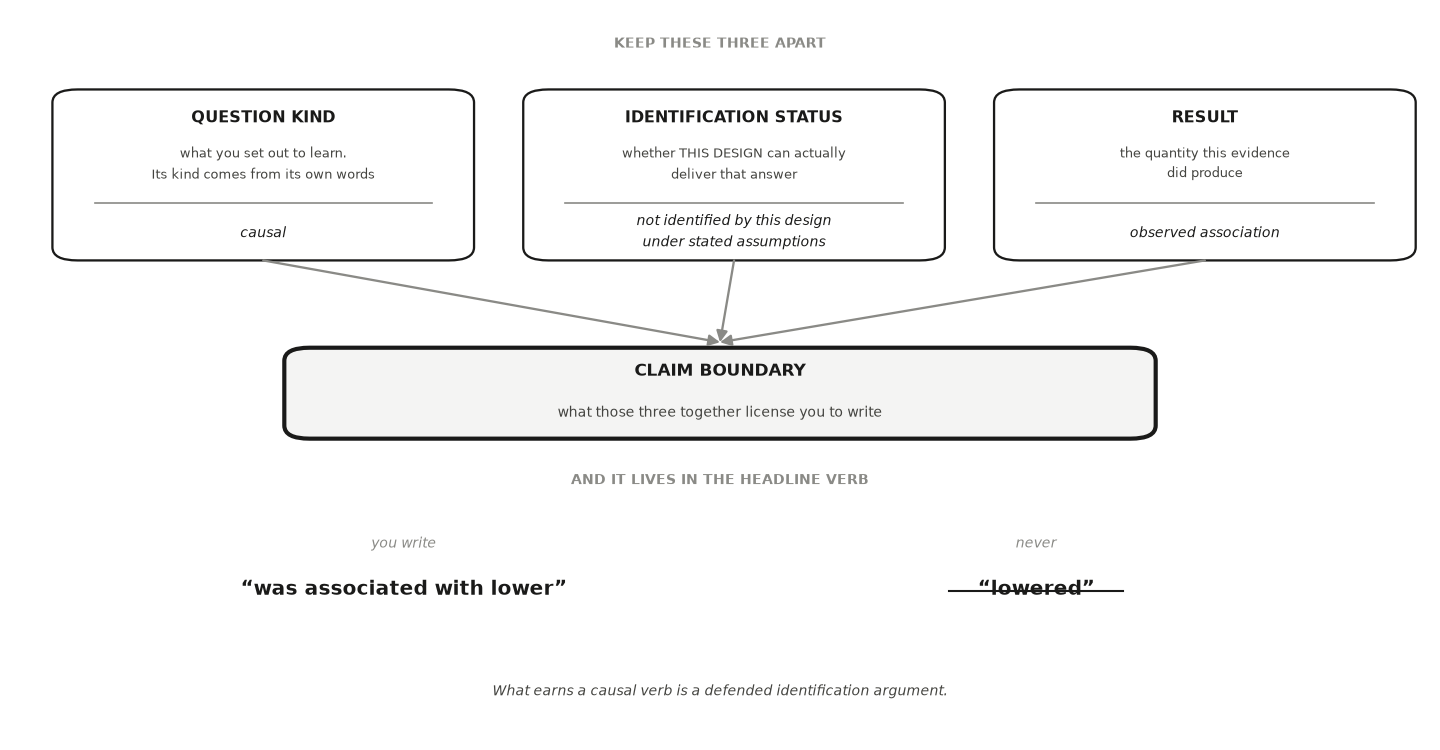
The kind belongs to the question; the status belongs to the design
Chapter 28 · The concept
Question
what you set out to learn, and its kind comes from its own words
Identification status
whether this design can actually deliver that answer
- “Does walking lower blood pressure?” asks what an intervention would change, so it is causal.
- It stays causal no matter which data you managed to collect.
- Watched who already chose to walk: not identified by this design, under the assumptions you can defend.
- Your result is then a descriptive association, real and worth reporting.
“Causal and unidentified” fuses two fields into one status
Chapter 28 · The concept
- The status never repeats the word “causal”.
- Written as one status, it fuses the two fields you just separated.
- Keep two lines: what the question asks, and what the design delivers.
Four lines you can reuse on any project
Chapter 28 · The concept
- Question kind: causal.
- Identification status: not identified by this design under stated assumptions.
- Result: observed association.
- Claim boundary: association only.
A defended identification argument is what earns a causal verb
Chapter 28 · The concept
Your claim boundary lives in the headline verb.
- With no identification argument you write “was associated with lower,” never “lowered.”
- What earns the causal verb is the argument, not the size of the gap (Hernán & Robins 2020).
- Randomizing is the cleanest way to get one.
- Observational designs can carry causal answers when their assumptions are argued and defended.
- What you may never do is use the verb without the argument.
Three fields kept apart decide one verb
Chapter 28 · The concept
- Question kind, identification status, and result stay three separate fields.
- Together they license the claim boundary, and it lives in the headline verb.
- With no identification argument you write “was associated with”, never “lowered”.
A bound a reader has to hunt for is a bound doing hidden work
Chapter 28 · The concept
- Print “about 6 points lower (95% interval: 1 to 11)” under the headline.
- The reader meets the doubt at the same moment as the number.
- The 6-point gap points back to the one line of code that computed it.
- A number you cannot trace cannot go up.
Forty volunteers, a 6-point gap, and a headline that reaches too far
Chapter 28 · A worked example
- A small human-physiology pilot: forty volunteers wear a step tracker for a month.
- Twenty walk at least 8,000 steps a day; twenty do not.
- Average resting systolic: 128 active, 134 less-active.
- The draft headline reads “Walking LOWERS blood pressure.”
- Two bars on an axis starting at 125, told apart by red and green alone.
The verb claims a crossing the design never paid for
Chapter 28 · A worked example
- The question behind this study is causal, and it stays causal.
- Nobody was assigned to walk.
- The active group may differ in age, diet, or baseline health.
- Fill the card, and the honest verb is “was associated with lower.”
Where the axis starts is part of the claim
Chapter 28 · A worked example
- Bars encode magnitude, so starting them at 125 makes 6 points look like a cliff.
- Start the bars at a meaningful zero.
- Better: plot the two group averages as points with their intervals.
- Use a blood-pressure scale a clinician would recognize.
- Label each bar with its value, so color is never the only channel.
Same result, a claim that survives the judge
Chapter 28 · A worked example
- Nothing about the result changed.
- The verb was downgraded, and the interval rides in the same eye-span.
- A boundary line names what the design does not establish.
In this sample, more-active volunteers averaged about 6 points lower resting systolic blood pressure (95% interval: 1 to 11); this is an observed association, and this design does not identify whether walking caused the drop.
The printout shows the difference the poster never did
Chapter 28 · A worked example
- The volunteers chose how much to walk, and age drives both.
- Watch the two group ages printed beside the 6-point gap.
- The age line is one difference you can see.
- The design leaves every unseen one untouched.
import numpy as np, pandas as pd
SEED = 464
rng = np.random.default_rng(SEED)

# Forty volunteers who CHOSE how much they walk. Age drives both.
n = 40
age = np.r_[rng.normal(31, 7, 20), rng.normal(43, 7, 20)]   # active are younger
active = np.r_[np.ones(20, bool), np.zeros(20, bool)]
systolic = np.round(112 + 0.5 * age + rng.normal(0, 6, n))

gap = systolic[~active].mean() - systolic[active].mean()
print(f"active group mean systolic      : {systolic[active].mean():.0f}")
print(f"less-active group mean systolic : {systolic[~active].mean():.0f}")
print(f"observed gap                    : {gap:.0f} points")
print(f"mean age, active vs less-active : {age[active].mean():.0f} vs "
      f"{age[~active].mean():.0f}")
print("\nnobody was assigned to walk. the age line is one difference you can")
print("see; the design leaves every unseen one untouched, so the verb stays")
print("'is associated with'")An AI failure case
Chapter 28
Where the tool failed
You paste your honest headline into a tool and ask it to make it “punchier.” It returns, with total confidence, “Walking Reduces Blood Pressure by 6 Points.” It reads beautifully and it is wrong. The tool upgraded your verb from an association to a cause and dropped your interval, a silent scope change dressed up as a copy edit.
How it failed
Chapter 28 · An AI failure case
- You catch it by comparing the new verb to what your design earned.
- Your question was causal and stays causal, but nobody was assigned to walk, so nothing identifies that answer and “reduces” claims a warrant you never held.
- You also notice the “6 points” now stands alone with no interval beside it.
- You revert to “was associated with about 6 points lower (95% interval: 1 to 11).” The fluent rewrite reviewed your style; only you can review your claim.
Do not delegate
Chapter 28
This stays yours
Three calls stay yours. You choose the verb in your headline, the one word that fixes your claim boundary. You make the defend-or-concede call when a question pushes on that boundary out loud. And you make the lock decision: the judgment that every number is traced, every citation resolves, and the claim is ready to be final. A tool can draft questions and hunt sources, but it cannot decide what your evidence licenses or when your claim is earned.
It is your turn
Chapter 28 · Your move
- List every result you might put in front of a reader, then write the claim sentence each one licenses.
- Check every verb against what your design established, and downgrade the ones that reach too far. “Caused” becomes “was associated with”; “predicts” becomes “flagged.”
- Write a boundary line beside each claim naming what it does not establish, and put the uncertainty in the same eye-span as the number.
- Trace every number back to the cell that produced it and cut the ones you cannot walk back.
- Log it in your AI Research Ledger, and verify at least one claim with a named method from the Verification Guide.
Work it in the companion notebook with Chapter 28 open beside it. Log every delegation in your AI Research Ledger.
Claim–Evidence Tables
Lesson 2 of this studio · Chapter 29
for each claim you make, which specific evidence backs it and where that evidence can be found
The research decision
Chapter 29
For every claim your work makes in public, decide which exact piece of evidence backs it, where that evidence lives, and what it does not establish. Then write all three in one row of a claim–evidence table, before the claim reaches anywhere a stranger can point at it.
One vague answer costs you every other number
Chapter 29 · Why this decision matters
- A research-integrity judge, working a poster hall, on what one answer decides.
- The doubt does not stay on that number. It reaches every other number up there.
Walk me to the line that made it and I trust the whole poster. Say ‘it’s in the analysis somewhere’ and I stop believing every other number up there.
The gap is between a claim you can say and one you can back
Chapter 29 · Why this decision matters
- A poster is a set of promises made in public.
- Each headline number, each figure, each cited fact: a stranger can test it in ninety seconds.
- A claim-evidence table closes that gap on purpose, before anyone points a finger.
- The honesty is built into the work, not patched under pressure.
One row per claim, and the row names its own evidence
Chapter 29 · The concept
- Claim-evidence table: a table with one row per claim, pairing each claim with the evidence behind it.
- Claim column: “Store B sold about 1.4 times as many units per week as Store A.”
- Evidence column: the two weekly sales averages.
Four columns carry each row, and Evidence is not Trace
Chapter 29 · The concept
Claim
the statement you assert as true
Evidence
the exact result or source that backs the claim, with its uncertainty
Trace
where a number was actually produced, named precisely enough to open
Boundary
the line between what the evidence licenses and what it does not
- Claim: “turnout in these precincts was 61.3 percent.”
- Trace: “cell 16, where
turnout = ballots.sum() / registered.sum()runs.” - Boundary: “one county, one midterm election, registered voters only, so this is not the statewide rate.”
A number you cannot walk back does not belong on the board
Chapter 29 · The concept
- Traceable number: one you can walk back to the notebook cell that computed it.
- Untraceable number: one you cannot walk back, typed from memory or rounded by hand.
- Building the table is the skill, and a blank cell is a visible hole.
- With every claim in a filled row, an unbacked claim has nowhere to hide (Munafò et al. 2017).
You build Row 1 before the file goes to the printer
Chapter 29 · A worked example
- Your political-science poster reports turnout in one county’s midterm election.
- Headline: “turnout in these precincts was 61.3 percent.”
- Row 1 claim: “turnout was 61.3 ± 1.8 percent.”
- Row 1 evidence: 30 sampled precincts, 47,871 ballots against 78,117 registered voters.
The table caught 63.0 before a judge did
Chapter 29 · A worked example
- You reach for the trace and the draft board reads 63.0, not 61.3.
- You had quietly written the officially reported statewide figure instead.
- Your own cell never produced 63.0.
- Filling Row 1 is what forced the catch.
Row 2 bounds itself: only two definitions were tested
Chapter 29 · A worked example
- Claim: “the estimate barely moves when I change how a registration counts as active.”
- Evidence: under two reasonable definitions the estimates differ by less than your sampling spread.
- Trace: cell 18, the definition comparison.
- Boundary: nothing is claimed about looser rolls that keep long-inactive registrations.
Two claims, two rows, every number walked back to a cell
Chapter 29 · A worked example
- Every boundary written down, before the file goes to the printer.
- That table is what lets your work survive a pointed finger.
- Tracing every reported claim to the line that produced it is the reproducibility reforms’ practical core (Munafò et al. 2017).
Run the traced line; that print is the only number Row 1 may carry
Chapter 29 · A worked example
- Watch the line marked
# the traced line. That is the address Trace points at. - The printed turnout and spread are what Row 1 copies, digit for digit.
- Any board figure this line does not produce is untraceable, whoever published it.
import numpy as np, pandas as pd
SEED = 464
rng = np.random.default_rng(SEED)

# Thirty sampled precincts: ballots cast and registered voters.
registered = rng.integers(2300, 3000, size=30)
rate = np.clip(rng.normal(0.625, 0.050, size=30), 0.35, 0.85)
ballots = np.round(registered * rate).astype(int)

turnout = ballots.sum() / registered.sum()                  # the traced line
spread = 1.96 * rate.std(ddof=1) / np.sqrt(len(rate)) * 100

print(f"precincts sampled  : {len(registered)}")
print(f"ballots cast       : {ballots.sum():,}")
print(f"registered voters  : {registered.sum():,}")
print(f"turnout            : {turnout*100:.1f} ± {spread:.1f} percent")
print("\nthat is the number your Trace cell must point at. any figure on the")
print("board that this line does not produce is untraceable, whoever published it")An AI failure case
Chapter 29
Where the tool failed
You paste your poster text and ask an AI tool to build the whole claim–evidence table for you. It returns a clean, complete grid, every cell filled, and the trace column reads confidently: “turnout value from cell 14.” You almost accept it. Then you open cell 14, and it totals the registered voters; it never divides. The rate you report is produced two cells later, in cell 16. The tool guessed a plausible cell number and filled it with full confidence, and its tidy finished table hid the wrong trace behind a polished look.
How it failed
Chapter 29 · An AI failure case
- You catch it by refusing to trust a trace you have not opened.
- Reading the actual cell, number in hand, is the whole discipline.
- A filled table is not a verified table.
Do not delegate
Chapter 29
This stays yours
The wording of each claim, the judgment that a piece of evidence actually backs it, and the boundary each claim carries stay yours. An AI can list claims and draft rows, but it cannot open your notebook cell to confirm a number is real, and it cannot decide the evidence is honest enough to print. The call that the table is complete and the work is locked is yours to declare and defend.
It is your turn
Chapter 29 · Your move
- Write one row per claim with four columns: claim, evidence, trace, boundary.
- Fill the evidence column with the actual result and its uncertainty, not a description of the result.
- Fill the trace column by opening the cell or the source and reading the number off the screen.
- Write each boundary as a sentence about what the row does not establish, then hunt for blank cells.
- Log it in your AI Research Ledger, and verify at least one traced number with a named method from the Verification Guide.
Work it in the companion notebook with Chapter 29 open beside it. Log every delegation in your AI Research Ledger.
AI Disclosure and Research Integrity
Lesson 3 of this studio · Chapter 30
which AI uses you disclose, and what you claim you did to check each one
The research decision
Chapter 30
Decide exactly what you will say about every AI tool you used: which tool, on which task, and how you checked what came back. Then record it, so when someone asks “did you use AI, and how did you verify it?” you answer from a checkable record instead of from memory.
The words this chapter uses
Chapter 30 · Key terms
AI disclosure
a truthful statement of where and how you used an AI tool in your work (International Committee of Medical Journal Editors 2026).
Research integrity
the practice of keeping your work honest and traceable, so a reader can see where each result came from and trust it (ALLEA – All European Academies 2023).
A result I cannot trace is a result I cannot trust
Chapter 30 · Why this decision matters
- Said by a conference reviewer, standing at your poster.
- The penalty is not for using the tool.
- The penalty is for not being able to say where, and how you checked.
“I am not going to penalize you for using an AI tool. I am going to penalize you for not being able to tell me where you used it and how you checked it. A result I cannot trace back to a source and a verification is a result I cannot trust.”
“Yes, a bit, and it seemed fine” turns good work into an untrustable result
Chapter 30 · Why this decision matters
- At your research conference, a stranger can ask you the AI-use question.
- Many journals and conferences now ask authors where and how AI tools were used.
- So it is not a formality you can wave off.
- Disclosure is what keeps an honest use of AI honest under questioning.
One sentence can name the tool, the task, and the check
Chapter 30 · The concept
- Which tool: the AI assistant you asked.
- For which task: drafting the code behind the coverage ratio.
- How you verified: recomputed by hand before reporting.
“I used Gemini to draft the code that computed my coverage ratio, and I recomputed that number by hand before reporting it.”
Drop any one of the three parts and the disclosure fails
Chapter 30 · The concept
Three parts make a disclosure complete by this book’s standard.
- Each part maps to a column in your ledger.
- “I used AI,” with no task named, is meaningless.
- A task with no verification is the gap a reviewer is trained to find.
A complete disclosure is read off your ledger, not written at the end
Chapter 30 · The concept
- Your AI Research Ledger is a running table with one row per AI use.
- Each row records the task, the tool, your decision, and the verification method.
- You have kept it since you opened it at the start of your project.
- So the disclosure is already written by the time you need it (Munafò et al. 2017).
A coverage ratio of 2.0 means the company earned twice what it owed
Chapter 30 · A worked example
- You are presenting a business-analytics poster on a public company’s debt.
- The question: can it comfortably pay the interest it owes?
- Your headline number is the interest coverage ratio.
- That is operating income divided by the interest owed in a year.
Two honest AI uses, and neither is safe until it is disclosed and verified
Chapter 30 · A worked example
- First use: finding the company’s reported operating income.
- Second use: writing the short calculation that turns income and interest into a ratio.
- Both are honest uses.
- Honest is not the same as checked.
Editorial guidance requires two of the three columns; the third is this book’s
Chapter 30 · A worked example
- Current guidance: name which tool you used, and for what purpose (International Committee of Medical Journal Editors 2026).
- Responsibility for accuracy and attribution stays with you.
- A tool can never be an author.
- How you verified is this book’s own requirement on top of that guidance.
A reported figure and a computed one need different checks
Chapter 30 · A worked example
Primary-source reading
you opened the company’s published annual report and confirmed the operating income the tool gave you
Alternative code
you recomputed the same number a second way, instead of trusting the AI-generated cell
Recompute the ratio by hand and watch it land on 2.11
Chapter 30 · A worked example
- The two inputs are 276 and 131, in USD millions, from the annual report.
- Watch the printed value against the number the AI-generated cell reported.
- The recomputation is the check, and the ledger row records that you ran it.
# The number the AI code reported, recomputed by hand.
operating_income = 276    # USD millions, confirmed against the annual report
interest_expense = 131    # USD millions, from the same annual report
coverage_ratio   = operating_income / interest_expense
print(round(coverage_ratio, 2)) # 2.11 — matches the AI-generated cellYou read the two rows aloud, and the claim stays bounded
Chapter 30 · A worked example
- The coverage ratio is about 2.1 for this fiscal year.
- Income confirmed against the annual report; the arithmetic reproduced by hand.
- You read a single year of reported results.
- Not a downturn scenario, and not the debt coming due next year.
An AI failure case
Chapter 30
Where the tool failed
You ask a tool to “write my AI-use disclosure from these notes,” and it hands back a polished paragraph: “All AI-generated outputs were independently verified against primary sources.” It reads beautifully, and it is false. You verified the operating income against the annual report, but you never independently checked the interest figure the same tool helped you pull. The sentence upgraded one real check into a blanket claim of “all.”
How it failed
Chapter 30 · An AI failure case
- You catch it by reading the disclosure line by line against your ledger.
- Every sentence claiming a verification must point to a row that names that check.
- The word “all” has no such row, so it is fabricated and comes out.
- Your true disclosure is narrower and stronger: you name the two checks you ran and the one input you did not independently confirm.
- A confident paragraph is not a truthful one.
Do not delegate
Chapter 30
This stays yours
The honesty of the disclosure is yours alone. You decide which uses to disclose (including the one you would rather not mention), whether a verification you claim actually happened, and whether the final statement is true. A tool can format your ledger into a clean paragraph. It cannot know what you really did or certify that you checked it. Signing your name to a disclosure you cannot back is the integrity failure this chapter exists to prevent.
It is your turn
Chapter 30 · Your move
- Read your AI Research Ledger end to end and list every use, including the one you would rather not mention.
- For each use, write the three parts a disclosure needs: which tool, for which task, and how you verified the output.
- Turn the rows into a short statement in your own words, then check every sentence against a row.
- Say what you did not verify.
- Log it in your AI Research Ledger, and verify the finished statement with a named method from the Verification Guide, such as peer reasoning.
Work it in the companion notebook with Chapter 30 open beside it. Log every delegation in your AI Research Ledger.
From Dossier to Research Note
Lesson 4 of this studio · Chapter 31
which finding leads your written note, and how big each claim is allowed to be once your voice is no longer in the room
The research decision
Chapter 31
When you turn your research dossier into a written note, decide which finding has earned the headline and exactly how big each claim is allowed to be given your evidence, then package the note so a stranger can rerun it and reach your number without you in the room. Whatever you present along the way — a poster, a talk, a brief — is one input to that note, never its source.
The words this chapter uses
Chapter 31 · Key terms
Working logic
how the dossier and any presentation of it speak: compressed records and, when you present, your live voice filling the silences.
Paper logic
communication that must stand alone on the page, where every claim is argued in prose because you are not there to answer.
The reviewer wants your most defensible result, not your flashiest
Chapter 31 · Why this decision matters
- The decision: which finding leads, and how big its claim is allowed to be.
- She is asking which finding you would still defend after the room empties.
- And whether she could rerun your work and watch the same number return.
“Show me your results in the order you trust them. If your flashiest number comes from one lucky run and it leads the paper, I already know how this review ends. I do not want your most surprising result first. I want your most defensible one.” — a conference reviewer
The note has no you standing next to it
Chapter 31 · Why this decision matters
When you present, your voice fills the silences. The page has no voice.
- Every leap a presentation lets you imply, the prose has to earn.
- In order, for a reader who will never hear you explain it.
- Whatever you present is one input to the note, never its source.
A poster’s Gap box says one line; the note argues the paragraph
Chapter 31 · The concept
- Working logic: compressed records, plus your live voice filling the silences.
- A Gap box reading only ‘few studies of wait times at peak hours’.
- Paper logic: every claim argued in prose, because you are not there to answer.
- The same gap, written out: what prior work covered, what it skipped, why that matters.
- Turning one into the other is not adding words. It is making the reasoning visible.
Problem, gap, question: the spine holds only when the gap is real
Chapter 31 · The concept
Problem–gap–question spine
the real trouble your work responds to, the specific thing prior retrievable work has not established, and the answerable question that closes exactly that gap
Evidence density
the share of a paragraph resting on sources a reader could open rather than bare assertion
- Problem: customers give up and leave during the morning rush.
- Gap: published wait-time studies measure only quiet, steady hours.
- Question: how much does mobile pre-order cut the wait during the rush here?
- ‘As everyone knows’ carries no density. A published figure a reader can recompute carries some.
Best-supported first, one lucky run last
Chapter 31 · The concept
Results hierarchy
the order you present findings in, best-supported first and fragile last
- A median measured over a thousand simulated mornings leads.
- One unusually fast order waits at the back, labeled exploratory.
- Limitations follow the same discipline, sized to what actually threatens the claim.
- ‘Measured on a simulated arrival pattern, not a real Saturday rush.’
- Not a generic ‘more research is needed.’
A note a reader cannot rerun is half a claim
Chapter 31 · The concept
Reproducibility capsule
everything a stranger needs to rebuild your number and nothing they must guess
Restart-and-run-all
clear everything, run every cell top to bottom, and the headline number returns
- Pinned data and tool versions.
- A fixed seed.
- A decision log.
- Your AI-use ledger.
‘38% faster’ is a table row, not yet a claim you can defend
Chapter 31 · A worked example
- You tested a mobile pre-order option for a campus coffee shop.
- Your claim–evidence table holds the headline row: ‘38% faster.’
- The note has to turn that row into a claim you can defend.
The 99% drop is one customer; the 38% is a thousand arrivals
Chapter 31 · A worked example
- Across a thousand simulated arrivals, median wait dropped about 38%.
- With a tight interval around it.
- One pre-ordering customer was served almost instantly: a 99% drop.
- The median leads. The lone customer goes to the back, as one observation.
Drop ‘median’ and ‘simulated’ and you promise what you never tested
Chapter 31 · A worked example
- Honest: ‘on this simulated arrival pattern, mobile pre-order cut median wait by about 38%.’
- Interval attached, and the boundary in the same sentence.
- ‘This is a measurement on simulated demand, not a guarantee for a real Saturday rush.’
- Refused: ‘mobile pre-order makes the shop 38% faster.’
- That drops the demand pattern, drops median, and promises every customer a shorter wait.
The capsule is what makes the 38% return on a clean kernel
Chapter 31 · A worked example
- Pin the simulation’s seed.
- Record the machine and library versions.
- Log that you excluded the first order of the morning, and why.
- Pass restart-and-run-all so the 38% comes back.
- The note is now readable and runnable.
The printout is already the note’s order of trust
Chapter 31 · A worked example
- The median drop prints with its interval, never on its own.
- The luckiest customer prints at the bottom, where the note puts it.
- The code labels that last line as one observation, not a result.
import numpy as np, pandas as pd
SEED = 464
rng = np.random.default_rng(SEED)

n = 1000
service = rng.gamma(2.0, 55.0, size=n)                  # ordinary counter service
preorder = rng.gamma(2.0, 36.0, size=n)                 # mobile pre-order

med_drop = 1 - np.median(preorder) / np.median(service)
boot = [1 - np.median(rng.choice(preorder, n)) / np.median(rng.choice(service, n))
        for _ in range(2000)]
lo, hi = np.percentile(boot, [2.5, 97.5])
luckiest = 1 - preorder.min() / np.median(service)

print(f"median wait, ordinary service : {np.median(service):.0f} s")
print(f"median wait, mobile pre-order : {np.median(preorder):.0f} s")
print(f"median drop                   : {med_drop*100:.0f}% "
      f"[{lo*100:.0f}%, {hi*100:.0f}%]")
print(f"the single luckiest customer  : {luckiest*100:.0f}% faster")
print("\nthe headline is the first number with its interval. the last one is")
print("one observation, and it goes at the back of the note labelled as such")An AI failure case
Chapter 31
Where the tool failed
You paste your discussion into your AI and ask it to make the writing sharper. It hands back cleaner prose, and it runs through your spell-check without a flag. Buried in the polish, one sentence has changed size. Your original said “median wait time dropped about 38% on this simulated arrival pattern.” The rewrite says “mobile pre-order makes the shop roughly 38% faster.” The word median is gone, the demand-pattern boundary is gone, and a measurement on simulated demand now promises every customer a shorter wait. The sentence reads better and claims more.
How it failed
Chapter 31 · An AI failure case
- You catch it by diffing the rewrite against your original sentence and against your printed result.
- The number came from a median over a seeded simulation, not a mean, and not a real Saturday rush, so the general claim is not licensed.
- You keep the edits that clarify and reject the one that inflated.
- Fluent prose is not evidence.
- You verify the claim, not the polish.
Do not delegate
Chapter 31
This stays yours
Three calls stay yours no matter how fluent the tool is. Which finding is your headline, how big that claim is allowed to be, and which sources are real are never delegated. An AI can sharpen a sentence, but a sharper sentence is not a bigger finding, and clean prose is exactly how an overclaim sneaks in. You own the words you put your name on, their boundary, and their uncertainty.
It is your turn
Chapter 31 · Your move
- Write your problem–gap–question spine as three short paragraphs.
- Order your findings, best-supported first.
- Write your headline claim in one sentence, with its boundary inside the same sentence: the setting, the sample, and the population it does not cover.
- Size your limitations to what actually threatens the claim.
- Assemble the full note, not only its spine: methods (what you did, so a stranger could follow), results with their uncertainty, a discussion sized to the claim, references, your AI-use disclosure placed where the venue expects it, and the pointer to the package Studio 11 will freeze.
- Attach your folder to the note and confirm the two agree: the number in your lead sentence is the number a cold restart-and-run-all prints.
- Log the drafting round in your AI Research Ledger, and verify at least one output with a named method from the Verification Guide.
Work it in the companion notebook with Chapter 31 open beside it. Log every delegation in your AI Research Ledger.
Milestone 9: Your bounded claims
Studio 9 closes here
What the lessons handed you becomes one artifact you can defend.
What this milestone produces
Milestone 9
The artifact
What this milestone produces. A stand-alone research note or report draft, a claim-to-evidence table, and your AI disclosure statement.
What you bring
Milestone 9 · Check before you start
- Lesson 28 — From Results to Claims: your claims with verbs downgraded to what the design established, each carrying its boundary line.
- Lesson 29 — Claim–Evidence Tables: your claim-evidence table, one row per claim with claim, evidence, trace, and boundary, every number traced to its output.
- Lesson 30 — AI Disclosure and Research Integrity: your AI-use disclosure, written from the ledger and naming what you did not verify.
- Lesson 31 — From Dossier to Research Note: your stand-alone note draft: the problem-gap-question spine, methods, results with uncertainty, discussion, ordered findings with the headline claim’s boundary inside, references, your disclosure placed, and the pointer to the package Studio 11 will freeze.
The practice
Milestone 9 · In the studio
- Write your claim as one sentence, with its boundary attached in the same sentence.
- Build the claim-to-evidence table: every claim, the output that supports it, and the check that verified it.
- State your uncertainty and your limitations in the words a reader outside your field would use.
- Write your AI disclosure from your ledger, not from memory.
The four rails, here
Milestone 9 · Every studio, these four
Ethics, permissions, and data exposure
Disclosure includes what you sent to tools, not only what they produced.
Evidence, provenance, and reproducibility
A claim with no row in the table does not appear in the draft.
AI activity, verification, and human decisions
The sentence that ships is yours, whatever drafted it.
Uncertainty, claim boundary, and revision history
Findings are never communicated as certainties.
A version, not a pass
Milestone 9
How the record works
Your milestone artifact is a dated, numbered version with the reason for the version attached. When later evidence changes it, you write the next version rather than editing the last one, because the sequence of changes is itself part of your research record.
The one rule
AI is your arm and your research assistant, not your brain.
AI can review AI, and a second model is a real auditor of the first. The last decision is always human.

EDR|AI · Studio 9 — Write, bound, and disclose