HONR 46400 · Evidence-Driven Research
Studio 12 — Special topic: agentic AI, release, and the next cycle
What you can defend when you leave
Studio 12
The book’s special topic, turned onto your finished project: direct an advanced multi-role AI review — agentic where your tools truly plan and act, human-sequenced otherwise — under your own rules, adjudicate what it returns, decide whether the work leaves your hands, and turn the largest unresolved limitation into the next study.
The milestone ahead
Studio 12
This studio closes with Milestone 12: Your release and next cycle, a short chapter of its own after the lessons. What it asks you to produce. A review-management record for your directed AI team, a release audit recording release or withhold-pending-a-named-repair, your final dossier with a complete manifest, an explicit stopping rule, and your next-study agenda.
The lessons in this studio
Studio 12 · Road map
- Lesson 38 — Managing Multiple AI Agents: your closing-review team: the loops’ scoped jobs, the dependency wiring and turn counts, and the one node you kept human.
- Lesson 39 — Conflicting Agents and Human Escalation: your escalation rules, and one load-bearing pair of outputs (agreeing or not) diagnosed and settled by your own check, with any override on record.
- Lesson 40 — Final Research and AI-Management Portfolio: your finished research artifact with every claim bounded, your AI-management portfolio with the team record inside, and the rehearsed three-movement defense.
Managing Multiple AI Agents
Lesson 1 of this studio · Chapter 38
how many AI loops you set running on one piece of your work, in what order, and which step you keep out of every one of them
The research decision
Chapter 38
Running several AI agents means running several loops at once. You decide how to split the work into scoped jobs, in what order those loops run so that no early mistake slips downstream, and which step in the chain no loop is ever allowed to close.
The words this chapter uses
Chapter 38 · Key terms
The AI loop
the cycle you have been running since the beginning of this book: you prompt, you read the output, you interrogate it, you refine the ask, you run it again.
Agentic tools
aI systems that run that loop on their own, deciding their own next step and calling their own tools between your turns (Yao et al. 2023).
Your advisor wants a draft, not a pile of AI output
Chapter 38 · Why this decision matters
Your thesis advisor, reading the draft you are about to defend.
- She does not want a louder chorus of tools.
- She wants to see that you broke the job into pieces and ordered them sanely.
- And that you stayed the one person deciding what the draft claims.
Bring me a draft, not a pile of AI output. I want to know which part each tool touched, what you told it to do, and how you checked it. If you cannot tell me that, you did not write it.
Four assistants at once is not four times safer
Chapter 38 · Why this decision matters
- One assistant can now draft, cite, critique, and polish in a single breath.
- So the temptation is to open four of them and feel four times as safe.
- Four roles with the same instructions tend to miss the same thing, then agree loudly.
- Each role is not one prompt. It is a loop, running until you or it stops.
- Unmanaged, four loops is four times the unsupervised work.
Every turn you did not read is a turn you did not supervise
Chapter 38 · The concept
- You ask for the citations to be checked.
- An agentic tool searches, reads, rechecks, and revises across several turns (Yao et al. 2023).
- It comes back to you only at the end.
- Faster, and every one of those turns went unwatched.
Split “improve my draft” into jobs you can pass or fail
Chapter 38 · The concept
Task decomposition
breaking one large job into smaller subtasks, each with a single clear owner (Malone & Crowston 1994)
Scoped role
an AI job narrow enough to state in one sentence and check in one pass
A finish line is what makes a loop safe to run
Chapter 38 · The concept
- A scoped role: flag every sentence in my results section that claims more than my sample can support.
- That role has a clear finish line. “Make it better” does not.
- The loop stops when the job is done.
- And you can tell from the outside whether it is.
A worker alone is confident about its own quality
Chapter 38 · The concept
- The worker-critic pair: one role produces something, a second, separate role attacks it.
- A worker drafts your limitations paragraph.
- A critic hunts for the limitation the worker left out.
- That confidence is exactly the blind spot the worker cannot see from the inside.
The chain you cannot shorten sets your minimum number of rounds
Chapter 38 · The concept
Dependency
a required order between two subtasks, where one needs the other’s output before it can start
Critical path
the longest run of must-follow-must steps in your workflow (Kelley 1961)
What runs together, and what cannot
Chapter 38 · The concept
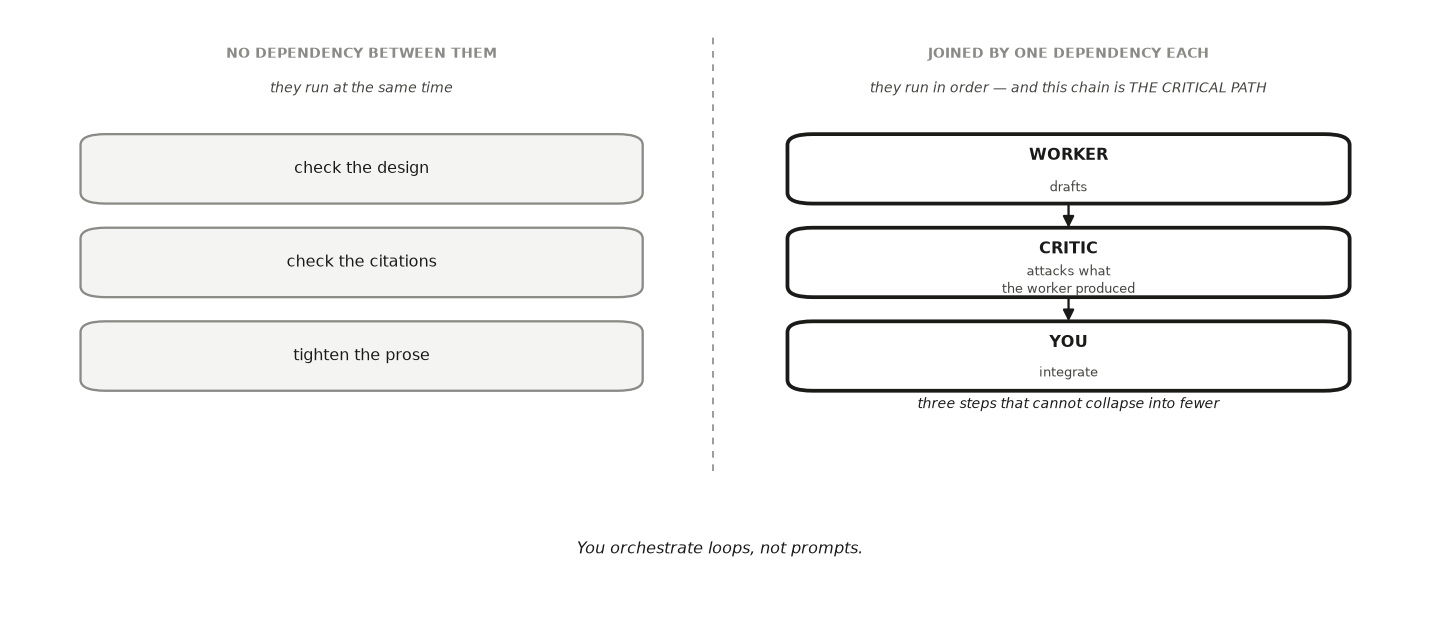
- Roles with no dependency between them run at the same time.
- Roles joined by one dependency run in order.
- Worker, critic, you: three steps that cannot collapse into fewer.
One draft, four roles, and a dorm-floor heart-rate study
Chapter 38 · A worked example
Is a ten-minute post-lunch walk associated with a lower afternoon resting heart rate on your dorm floor?
- You have a draft and four AI roles waiting.
- Clarity reviewer: does each sentence read plainly?
- Methodologist: is “associated with” the honest word for what your data can show?
- Citation-checker: are the two heart-rate studies real, and do they say what you claim?
- Editor: tighten the prose.
Three critics read the same draft at the same moment
Chapter 38 · A worked example
- The worker drafts your limitations paragraph first.
- No critic needs another’s output, so all three read it in parallel.
- The citation-checker may run four or five turns, and report a study it cannot find.
- Then you integrate their notes, and the editor tightens what survives.
- Worker to critic, critic to you, you to editor: three arrows deep.
The slowest critic sets the schedule
Chapter 38 · A worked example
- Compare all five roles in sequence against the three critics in parallel.
- The critical path prints as worker, then the slowest critic, then editor.
- So speeding up the other two critics buys nothing.
- The integration node is yours, and it is not in this table.
import numpy as np, pandas as pd
SEED = 464
rng = np.random.default_rng(SEED)

# Turns each role actually needs. The three critics do not wait on each other.
roles = {"worker: draft limitations": 3, "clarity reviewer": 2,
         "methodologist": 3, "citation-checker": 5, "editor: merge": 2}
turns = {r: int(rng.integers(max(1, n - 1), n + 2)) for r, n in roles.items()}

worker = turns["worker: draft limitations"]
critics = {r: t for r, t in turns.items() if "review" in r or r in
           ("methodologist", "citation-checker")}
merge = turns["editor: merge"]

serial = sum(turns.values())
parallel = worker + max(critics.values()) + merge
print(pd.Series(turns, name="turns").to_string())
print(f"\nall five in sequence      : {serial} turns")
print(f"three critics in parallel : {parallel} turns")
print(f"critical path             : worker -> {max(critics, key=critics.get)}"
      f" -> editor")
print("\nthe slowest critic sets the schedule, so speeding up the other two")
print("buys nothing. and the integration node is yours, not the editor's")
The integrate step is the one node with no loop attached
Chapter 38 · A worked example
- The methodologist says your walk-and-heart-rate result is only an association.
- The clarity reviewer loved the sentence that called it an effect.
- No role settles that clash. You do.
- The decision about what the write-up claims never enters the workflow as a delegated task.
An AI failure case
Chapter 38
Where the tool failed
You ask a tool to design your multi-agent workflow, and it returns a confident, well-formatted plan: run the worker, the methodologist, the skeptic, and the editor all in parallel to “save rounds.” The plan runs in your head without a hitch. Here is the trap. The editor and the skeptic have nothing to read yet, because the worker has not drafted anything. The tool scheduled three roles to start before the input they depend on exists, and dressed it up as efficiency. Hand that plan to an agentic tool that executes it for you and the failure gets quieter, not louder: three loops run on an empty draft and return three confident reviews of nothing.
How it failed
Chapter 38 · An AI failure case
- You catch it by drawing the arrows and asking one question at each role: does this role’s input exist at the moment it starts?
- The editor’s input is the integrated draft, which does not exist until the end, so “editor in parallel with worker” is impossible.
- Redrawn honestly, the plan is a critical path three arrows deep, not one.
- A green, tidy plan is not a valid one.
- You check the dependencies, not the confidence.
Do not delegate
Chapter 38
This stays yours
The split and the order can be informed by a tool, but three calls stay yours alone. You decide which jobs are worth their own loop and which just multiply output you cannot supervise. You decide the order, so that no role settles a question a role upstream of it should have answered first. And you keep the integrate step human: when two roles disagree about what your draft claims, you make that call in your own words. A workflow that hands the claim to a tool is not a workflow you can defend. The rule scales with the number of loops rather than bending to it. More agents does not mean looser command; it means the same command discipline, repeated.
It is your turn
Chapter 38 · Your move
- Pick one real section of your project to revise: your methods, your results, or your limitations.
- Set up three loops, each with a one-sentence job you could grade.
- Wire them, and declare each role’s capability while you do: who executes it, who chooses its next step (you, a script, or the tool), what tools it may touch, and what receipt it leaves.
- Name the one node you keep human, the step where the loops’ work becomes your claim, and write down why no role is allowed to take it.
- Run the round.
- Log every loop in your AI Research Ledger, and verify at least one output with a named method from the Verification Guide.
Work it in the companion notebook with Chapter 38 open beside it. Log every delegation in your AI Research Ledger.
Conflicting Agents and Human Escalation
Lesson 2 of this studio · Chapter 39
whether agreement among your AI reviewers is evidence or an echo, and the moment you halt the loops and decide for yourself
The research decision
Chapter 39
Your loops have come back and they do not match, or they match a little too well. You decide which of three things you are looking at (real disagreement, correlated error, or manufactured consensus), and you decide the exact moment to stop the loops and take the call into your own hands.
The words this chapter uses
Chapter 39 · Key terms
Real disagreement
when the roles genuinely read the evidence differently.
Correlated error
when the roles agree, but on the same wrong assumption, so the agreement proves nothing.
False consensus
when the roles agree only because your prompt framed the task so they had to.
Escalation to human judgment
the moment an AI output would settle rather than inform a decision that is yours, so you stop and decide it yourself (Bansal et al. 2021).
Agreement is the easiest thing in the world to manufacture
Chapter 39 · Why this decision matters
- A skeptical peer at your practice defense puts it to you like this.
- The question is not whether they agreed.
- It is whether they could have agreed for the same wrong reason.
Don’t tell me your reviewers agreed. Tell me whether they could have agreed for the same wrong reason. Agreement is the easiest thing in the world to manufacture, and the most dangerous to trust.
Three loops built the same way make one mistake three times
Chapter 39 · Why this decision matters
- You can run a small team of AI roles, so you can run several loops at once.
- The seductive thought: three roles blessing your draft means three confirmations.
- Same build, same draft, same instructions, so they tend to make the same mistake.
- A loop that keeps running polishes the last answer instead of testing it.
When two roles clash, do not pick a winner yet
Chapter 39 · The concept
- Reconciling conflicting outputs: decide what to believe by first diagnosing why the roles differ.
- Before you side with the reviewer over the methodologist, ask what would make each of them right.
- There are three cases, and they call for opposite responses.
Real disagreement is the good case
Chapter 39 · The concept
- Your reviewer calls a sentence clear and strong.
- Your methodologist flags that same sentence as reaching past your data.
- The roles genuinely read the evidence differently.
- The clash points straight at the claim you need to check.
Correlated error: one wrong assumption, agreed three times
Chapter 39 · The concept
- Three reviewers built from the same base model all miss the same flaw.
- They share the blind spot, so their agreement proves nothing.
- Ask the simple question: could they be wrong the same way?
- If yes, their consensus is one signal, not three (Peker 2023).
Ask a role to confirm your draft and you led the witness
Chapter 39 · The concept
- You ask “confirm my draft is ready,” and every role obliges.
- The roles agreed only because your prompt framed the task so they had to.
- You led all the witnesses.
- Reframe the ask neutrally and run it again.
Agreement counts only when the roles could have failed apart
Chapter 39 · The concept
Independence check
a test that makes agreement worth more than a head-count, either an independent method you run yourself or a way you force two roles to be genuinely independent
Human override
you take the pen back and make the call in your own words, backed by your own check, even when the roles agreed on something else
Write your stopping triggers before the round starts
Chapter 39 · The concept
- An agentic tool left running keeps looking for a next step.
- If nobody halts it, it takes the decision by default.
- Escalate when an AI output would settle a decision that is yours (Bansal et al. 2021).
- A trigger you decide with three tidy reviews in front of you is a mood.
250 adults outside the library, and a tidy 4.0%
Chapter 39 · A worked example
- The unemployment rate is the share of people who want paid work and cannot find it.
- You asked 250 adults outside the public library, over three weekday afternoons.
- Working, or looking for work? You divided one count by the other.
- Your draft: “unemployment here is 4.0%, in excellent agreement with the official rate.”
Three roles blessed it because all three expected a number near 4%
Chapter 39 · A worked example
- All three reviewer roles returned the same verdict: “Looks solid. Matches the published figure.”
- Each one already expects a number near 4%, the range familiar headline rates sit in.
- So each pattern-matches your estimate and blesses it without checking how you got there.
- That is correlated error wearing the mask of confirmation.
Your sample never met anyone who was at work
Chapter 39 · A worked example
- You asked 250 people, so the luck of who walked by is worth a couple of percentage points.
- Weekday afternoons outside a library exclude almost anyone at work all day.
- The tidy “4.0%” was luck riding on an honest-looking method.
- The shared anchor to the familiar figure hid that mistake from all three roles.
You take the pen back: 4.0% ± 2.4 percentage points
Chapter 39 · A worked example
- The agreement would settle your headline claim, and that claim is yours.
- You recompute from your raw responses, carrying the uncertainty of 250 people through.
- Consistent with the official rate, far less precise, and from a group missing most workers.
- You override three “looks great” verdicts and rewrite the claim with its real uncertainty.
- The roles counted the answer as correct. You checked whether it was earned.
Two defensible definitions, two different numbers
Chapter 39 · A worked example
- SEED = 464, so the same 250 respondents come back on every run.
- Watch the two printed rates: yours, then the one counting everyone who wants work.
- Neither number is the one the three reviewers blessed.
import numpy as np, pandas as pd
SEED = 464
rng = np.random.default_rng(SEED)

# 250 adults asked outside the library on three weekday afternoons.
n = 250
employed_ft = rng.random(n) < 0.58     # daytime library sample skews non-working
wants_work = np.where(employed_ft, False, rng.random(n) < 0.24)
looking = wants_work & (rng.random(n) < 0.20)   # only some are actively looking

labour_force = employed_ft.sum() + looking.sum()
your_rate = looking.sum() / labour_force
official_style = wants_work.sum() / (employed_ft.sum() + wants_work.sum())

print(f"respondents            : {n}")
print(f"in your labour force   : {labour_force}")
print(f"counted as unemployed  : {looking.sum()}")
print(f"your rate              : {your_rate*100:.1f}%")
print(f"same people, counting everyone who WANTS work: "
      f"{official_style*100:.1f}%")
print("\ntwo defensible definitions, two different numbers, from one sample")
print("that never met anyone at work on a weekday afternoon. three reviewers")
print("who only checked whether the answer LOOKED right caught none of it")An AI failure case
Chapter 39
Where the tool failed
You send your draft to four AI roles and all four reply “no major problems.” It feels like overwhelming confirmation, and it is confidently wrong. The four share a base model and read the same draft with the same instructions, so they share a blind spot. Whenever your one real flaw falls inside that blind spot, all four miss it together. Their unanimous “fine” is close to a single voice, not four. Running each loop longer does not rescue you either. Four loops with the same blind spot, given more turns, return the same verdict with better paragraphs around it.
How it failed
Chapter 39 · An AI failure case
- You catch it by refusing to treat agreement as evidence.
- You run an independence check: re-read the flagged claim against your own inquiry declaration, or hand the draft to a role with a different framing and different context.
- In the lab you will see the size of this trap measured.
- Four correlated reviewers miss a real flaw about seven times as often as four independent ones, and piling on more correlated roles cannot close the gap.
Do not delegate
Chapter 39
This stays yours
Which claims your draft can defend, where each claim must stop, whether an agreement among your roles was ever independent, and the moment to escalate: those stay yours. No role decides its own trustworthiness, and no head-count of roles decides your claim boundary or your ethics. When an AI output would settle one of those rather than inform it, you stop and you decide.
It is your turn
Chapter 39 · Your move
- Write your escalation rules before the next round starts.
- Add the stopping conditions that are not about content.
- Take one load-bearing pair of outputs your roles have returned, whether they agree or disagree, and diagnose it on the record: real disagreement, correlated error, genuinely independent agreement, or a consensus your own prompt manufactured.
- Resolve it yourself with a check the loops cannot run: recompute the number, open the source, or compare against a figure that was never in any prompt.
- Take one place your roles agreed on something that mattered and test whether the agreement was independent.
- Log the pair you examined, your diagnosis, and the check that settled it in your AI Research Ledger, with the override on record when you made one, and verify at least one output with a named method from the Verification Guide.
Work it in the companion notebook with Chapter 39 open beside it. Log every delegation in your AI Research Ledger.
Final Research and AI-Management Portfolio
Lesson 3 of this studio · Chapter 40
which of your claims you are willing to be wrong about in public, and what record you can show for how you checked them
The research decision
Chapter 40
Out of everything your project produced, you decide which claims you will stand behind in public, and you assemble the record that shows how you ran your AI team, what you kept in your own hands, and how each surviving claim was checked.
The examiner does not count your tools
Chapter 40 · Why this decision matters
- The decision on the table has two parts.
- Which of your claims you are willing to be wrong about in public.
- And what record you can show for how you checked them.
“By the time you stand up to defend, I do not count your tools. I ask which claims you are willing to be wrong about in public, and whether you can show me you checked them yourself.” — a defense examiner, opening the folder you handed over
A pile of AI-assisted work is not defensible
Chapter 40 · Why this decision matters
- Months of AI-assisted work leave drafts, role outputs, half-finished checks.
- Left in a pile, none of it is defensible.
- The examiner will not read the pile.
- She asks which claims you own, where each stops, and how you know.
The release audit does not change with the destination
Chapter 40 · The concept
- It is the last check you run before work leaves your hands.
- Does every promise the work makes still hold up?
- Held up by the evidence, the permissions, and the record.
- What you assemble for that audit is your dossier.
Your final submission has two halves
Chapter 40 · The concept
A research portfolio
the assembled body of your finished work: your claims, the evidence behind them, and the verification that makes each one defensible (ALLEA – All European Academies 2023)
An AI-management portfolio
the honest record of how you ran your AI work from the first curiosity to the last check: which tasks you delegated, where you took the decision back, and which calls you never handed to a tool
“When the roles all agree” is a trap
Chapter 40 · The concept
A stopping rule is a written statement of what “done” means, phrased around your own verified confidence rather than the tools’ agreement (Nosek et al. 2018).
- It is the decision that closes both halves of your submission.
- A team of look-alike tools can agree loudly and be wrong together.
- The rule that works names a check you ran yourself.
“I stop when I can defend each surviving claim to a hostile reviewer with a check I ran myself (National Academies of Sciences, Engineering, and Medicine 2019).”
Three reviewers who oblige tell you nothing
Chapter 40 · The concept
False consensus
agreement that exists only because the tools shared a blind spot or you asked a leading question
An independence check
a step that makes agreement worth more than a head count: a check you run yourself, outside the tools
An evidence defense names what you do not claim
Chapter 40 · The concept
- A short public defense of your claims at their boundaries.
- Then questions you cannot rehearse for.
- You state what you found, and name exactly what you do not claim.
- You answer each question from your own record.
The 88% came from one packet in three trays of 50
Chapter 40 · A worked example
- A germination test lays a counted number of seeds on damp paper.
- Steady warmth and light; count the sprouts after a fixed number of days.
- One packet of lettuce seed, three trays of 50 seeds each, 88% on average.
- Now you choose the claim you will defend.
The two roles disagreed, and the disagreement was a gift
Chapter 40 · A worked example
- You run three AI reviewer roles on your draft.
- One praises your headline: “Lettuce seed germinates at 88%.”
- A diagnostician role flags the same sentence for reaching past your evidence.
- You tested one packet in three trays, not lettuce seed in general.
- You take the pen back.
The narrower sentence is the one you will defend
Chapter 40 · A worked example
- The sentence now carries the packet, the design, and the spread.
- Reporting what your evidence holds, with the spread that produced it, is the reproducibility standard (National Academies of Sciences, Engineering, and Medicine 2019).
“This packet, tested in three trays of 50, averaged 88% germination, with the trays spanning 84% to 92%.”
Run the trays and watch the spread the claim is built from
Chapter 40 · A worked example
- The block runs the germination test tray by tray, with SEED = 464.
- Watch the three tray rates first, then the printed spread.
- The defensible sentence carries all three numbers, not the 88% alone.
import numpy as np, pandas as pd
SEED = 464
rng = np.random.default_rng(SEED)

# Three trays of 50 seeds from ONE packet. Trays differ; seeds within a tray
# share their tray's conditions.
trays = []
for tray, sprouts in enumerate([42, 44, 46], start=1):      # 50 seeds per tray
    seeds = rng.permutation(np.r_[np.ones(sprouts), np.zeros(50 - sprouts)])
    trays.append({"tray": tray, "sprouted": int(seeds.sum()),
                  "rate %": round(seeds.mean() * 100)})
df = pd.DataFrame(trays)
print(df.to_string(index=False))
print(f"\naverage across the three trays : {df['rate %'].mean():.0f}%")
print(f"tray-to-tray spread            : {df['rate %'].min():.0f}% to "
      f"{df['rate %'].max():.0f}%")
print("\nthe defensible sentence carries all three numbers: this packet,")
print("three trays of 50, and the spread — not 'lettuce seed germinates at 88%'")The packet’s label was never part of your AI workflow
Chapter 40 · A worked example
- The label states a germination rate of 85%.
- You compare your 88% against it by hand.
- The two numbers land close, and that is real reassurance.
- Your stopping rule is now satisfied, so you stop.
Four things go into the AI-management portfolio
Chapter 40 · A worked example
- The roles you ran.
- The reviewer-versus-diagnostician conflict, and your override.
- This stopping rule.
- The label comparison that made agreement worth more than a head count.
An AI failure case
Chapter 40
Where the tool failed
You send your finished draft to three reviewer roles and ask each to “confirm it is ready to submit.” All three return the same verdict: “Looks solid, no major problems.” It feels like three confirmations. It is one. The three roles run on the same base model, you gave them the same leading prompt, and they share a blind spot: none flags that your headline number carries no uncertainty, no range across your three trays. That is false consensus, and trusting it would send an overclaimed result into your defense.
How it failed
Chapter 40 · An AI failure case
- You catch it with a reframe and a check the tools cannot see.
- First you drop the leading ask and run a neutral one: “List the three weakest claims in this draft and why.” Now a role names the missing range.
- Then you leave the tools entirely and recompute the spread of your trays yourself, which hands you the 84% to 92% boundary the reviewers all skipped.
- The lesson is blunt: agreement is worth only the independence behind it.
- Count the checks you ran yourself, never the roles that nodded.
Do not delegate
Chapter 40
This stays yours
The tools may draft, review, and surface hard questions. They may never decide which claims you put your name on, where a claim like “88% germination” must stop, whether your reviewers were ever independent, what your stopping rule is, or a single word of the public defense. When agreeing roles bless a claim, deciding whether that agreement is real or just correlated is yours. So is the answer you give when the room asks how you know.
It is your turn
Chapter 40 · Your move
- Finish the research artifact itself: your paper, note, or poster, with each claim stated at its boundary and your uncertainty in the same sentence as your headline number.
- Assemble your AI-management portfolio around the team you directed in this studio: the decomposition of loops with their wiring, one conflict or suspicious agreement settled by your own non-AI check, your stopping rule and never-delegate list, and one independence check that made an agreement worth more than a head count.
- Write your stopping rule as a sentence you could read aloud, phrased around what you have verified rather than what your tools approved. “Every surviving claim has a check I ran myself” is a stopping rule. “The reviewers agreed” is not.
- Rehearse the defense in three movements: your claim and its boundary, the central choice you made and the road you did not take, and the verification you lead with.
- Read the whole artifact once more against your ledger and cut anything you cannot trace to a check.
- Close the ledger with the last entry, and verify your headline claim one final time with a named method from the Verification Guide.
Work it in the companion notebook with Chapter 40 open beside it. Log every delegation in your AI Research Ledger.
Milestone 12: Your release and next cycle
Studio 12 closes here
What the lessons handed you becomes one artifact you can defend.
What this milestone produces
Milestone 12
The artifact
What this milestone produces. A review-management record for your directed AI team, a release audit recording release or withhold-pending-a-named-repair, your final dossier with a complete manifest, an explicit stopping rule, and your next-study agenda.
What you bring
Milestone 12 · Check before you start
- Lesson 38 — Managing Multiple AI Agents: your closing-review team: the loops’ scoped jobs, the dependency wiring and turn counts, and the one node you kept human.
- Lesson 39 — Conflicting Agents and Human Escalation: your escalation rules, and one load-bearing pair of outputs (agreeing or not) diagnosed and settled by your own check, with any override on record.
- Lesson 40 — Final Research and AI-Management Portfolio: your finished research artifact with every claim bounded, your AI-management portfolio with the team record inside, and the rehearsed three-movement defense.
The practice
Milestone 12 · In the studio
- Check that nothing moved since your Studio 11 cold run: any change to the package — a number, a claim, the data, the code, the environment record, or the instructions a stranger would follow — makes that run stale. Repeat it before you release.
- Run the closing review as a directed team: scoped loops (a writer, a skeptic, an auditor at minimum), wired so each role’s input exists before it starts, escalation rules written first, one node kept human. Declare who chooses each next step — you, a fixed script, or an agent that plans and calls tools — and never call a manually sequenced chat autonomous. A single well-run assistant playing the roles in turn is a legal team; record what you actually ran, never invented activity.
- Run the release audit and mark each item clear, pending, or blocking: permissions, participant promises, disclosure, package-matches-cold-run, reproducibility, claim boundaries, and uncertainty.
- Make the release decision. A blocking item means withhold pending the named repair, written as this version’s reason — not a euphemistic release.
- Assemble the dossier with a manifest: contract versions, evidence registry, permissions, measurement, your cycle log and claim-evidence table, AI ledger, artifacts, package, and revision history — each marked present, absent with reason, or not applicable.
- Write your stopping rule: why you are stopping here rather than running one more check, stated as a decision.
- Write the next-study agenda: tie the next question to an unresolved limitation, a warrant gap, or something this cycle’s evidence opened.
The four rails, here
Milestone 12 · Every studio, these four
Ethics, permissions, and data exposure
Release is the last point at which a permission problem can still be prevented.
Evidence, provenance, and reproducibility
The dossier is the evidence rail made assemblable.
AI activity, verification, and human decisions
This studio is the ledger’s graduation — loop wiring, conflicts, overrides, and independence checks all land as rows before it closes; record the team you actually ran.
Uncertainty, claim boundary, and revision history
State what you still do not know as clearly as what you found.
A version, not a pass
Milestone 12
How the record works
Your milestone artifact is a dated, numbered version with the reason for the version attached. When later evidence changes it, you write the next version rather than editing the last one, because the sequence of changes is itself part of your research record.
The one rule
AI is your arm and your research assistant, not your brain.
AI can review AI, and a second model is a real auditor of the first. The last decision is always human.

EDR|AI · Studio 12 — Special topic: agentic AI, release, and the next cycle