HONR 46400 · Evidence-Driven Research
Studio 11 — Reproduce and package
What you can defend when you leave
Studio 11
Prove that someone who is not you can obtain your result from your materials.
The milestone ahead
Studio 11
This studio closes with Milestone 11: Your reproducible package, a short chapter of its own after the lessons. What it asks you to produce. An independent cold-run record and a reusable research package. Working alone, the record is a clean-environment rerun labeled “solo proxy; external cold run pending” — the label, and the honesty it enforces, are part of the artifact.
The lessons in this studio
Studio 11 · Road map
- Lesson 36 — Replication and Reproduction: your cold reproduction record: every number re-run from the top, one undisclosed choice varied, and missingness classified before any filling.
- Lesson 37 — Open and Reusable Research Packages: your research capsule: the runnable notebook, the data-provenance note with its terms of use, the fixed seed, the decision log, your AI-use ledger, the environment record, the README, and a cold rerun in a second environment.
Replication and Reproduction
Lesson 1 of this studio · Chapter 36
whether a result regenerates from the files alone, and which of its weaknesses most endangers the claim
The research decision
Chapter 36
Handed nothing but the files a study shipped, yours or someone else’s, you decide whether the reported number actually comes back out. Then you rank the weaknesses you found by how much each one threatens the headline claim, not by how easy each one is to fix.
The words this chapter uses
Chapter 36 · Key terms
Reproduction
getting the same number from the same data and code a study shipped (National Academies of Sciences, Engineering, and Medicine 2019).
Replication
getting a similar result from a new study or new data.
Hand me your files and let me get the same number back out
Chapter 36 · Why this decision matters
- The decision: whether a result regenerates from the files alone.
- Then: which of its weaknesses most endangers the headline claim.
I do not care that your figure is pretty or that the code ran on your laptop. Hand me your files and let me get the same number back out. If I cannot, you do not have a result yet. You have a story. — a principal investigator reading a first-year researcher’s lab report
A poster can round, and a clean notebook can still hide one choice
Chapter 36 · Why this decision matters
- A poster can round. A caption can overstate.
- The one choice holding the whole claim up rarely announces itself.
- You review someone else’s package first, before anyone reviews yours.
- Rank what you find by threat to the claim, not by ease of repair.
You test the package, not the world
Chapter 36 · The concept
- Reproduction: the same number from the same data and code a study shipped (National Academies of Sciences, Engineering, and Medicine 2019).
- You open another researcher’s notebook, run it top to bottom, check the figure comes back.
- Replication: a similar result from a new study or new data.
- A second lab runs its own experiment and sees the same effect.
- This chapter is about reproduction.
Restart, run every cell from the top, and see whether the headline returns
Chapter 36 · The concept
Reproducibility package
the full bundle a study ships so someone else can rebuild its numbers: the data, the code, the run order, any random seed, and the write-up
Headline number
the one figure the main claim rests on
Restart-and-run-all
clearing the notebook’s memory and running every cell from the top with no manual fixes
- A headline number sounds like this: “the supplement raised larval growth by 0.5 mm.”
- If a number only appears when cells run out of order, it is not reproducible (Wilson et al. 2017).
A clean run proves the code executes, not that the write-up is true
Chapter 36 · The concept
Claims-vs-computation agreement
checks that every sentence the write-up asserts is backed by a number the code actually prints
Alternative specification
a different but equally defensible way to compute the same headline, to see whether the answer depends on an undisclosed choice
Hidden assumption
a claim the analysis quietly relies on and never states, which the result would collapse without
Pseudoreplication
treating repeated measurements from the same animal, plate, or tank as independent data points when the real experimental unit is the animal, plate, or tank
- Three audits run on top of the clean run.
- The most dangerous hidden assumption in biology has a name.
Six tanks, 240 larvae, and a poster that says 0.5 mm
Chapter 36 · A worked example
- A package from another lab tests a probiotic added to zebrafish tank water.
- Three tanks get the probiotic, three get plain water.
- Each tank holds about 40 larvae, and body length is recorded for every larva.
- The poster reads: “The probiotic increased larval body length by 0.5 mm.”
- The figures in this worked example are constructed.
The code says 0.43. The write-up says 0.5.
Chapter 36 · A worked example
- You restart-and-run-all. The code splits larvae by tank type and differences the means.
- The package reproduces, which is a real success.
- Rounding does not explain the gap: 0.43 rounds to 0.4.
- That mismatch is your first finding, and it earns you the right to push harder.
Death after treatment is not an ordinary blank cell
Chapter 36 · A worked example
- The package dropped larvae that died before the final measurement and never said so.
- Post-treatment event: something that happens after treatment and that treatment may cause.
- If the probiotic changes which larvae survive, the survivors differ between tanks.
- Their length difference is then a comparison between different populations.
Carrying a dead larva’s last length forward is a claim about biology
Chapter 36 · A worked example
- That patch produces 0.31 mm. Resist calling it an equally defensible alternative.
- It assumes a last measurement stands in for a final length the larva never had.
- 0.43 and 0.31 answer different questions with different assumptions.
- The gap between them is not a range, and reporting it as one is a third error.
Report survival by tank type first, then length among the survivors
Chapter 36 · A worked example
- Label that pair as exactly what it is.
- It is an honest description of what happened in the tanks.
- It does not deliver an overall causal effect of the probiotic on day-30 length.
- Matching survival percentages do not rescue the comparison.
Six tanks, not 240 larvae, and the interval reaches zero
Chapter 36 · A worked example
- The package reports its gap as if all 240 larvae were independent.
- The probiotic was assigned by tank, so tankmates share water, food, and crowding.
- Average each tank first, then compare three treated tanks against three controls.
- The point estimate barely moved. The honest uncertainty around it exploded.
Rank by threat to the claim, not by ease of repair
Chapter 36 · A worked example
- First: pseudoreplication, because it can dissolve the “clear effect” claim.
- Second: the undisclosed handling of dead larvae, which decides which larvae the number describes.
- Third: 0.43 reported as 0.5, real and a genuine reporting failure.
- It is also the smallest threat to whether an effect exists.
Three defensible numbers, and none of them is 0.50
Chapter 36 · A worked example
- Watch the death counts: the probiotic changes who dies.
- Compare survivors, everyone, and tank means against the poster’s 0.50 mm.
- The unit of randomization was the tank, not the larva.
import numpy as np, pandas as pd
SEED = 464
rng = np.random.default_rng(SEED)

tanks = pd.DataFrame({"tank": range(6), "probiotic": [True]*3 + [False]*3})
rows = []
for _, t in tanks.iterrows():
    n = 40
    tank_effect = rng.normal(0, 0.25)                  # tanks differ, larvae cluster
    length = (4.60 + 0.25 * t.probiotic + tank_effect
              + rng.normal(0, 0.35, size=n))
    # death is a POST-TREATMENT event, and the probiotic changes who dies
    died = rng.random(n) < np.where(t.probiotic, 0.06, 0.18) * (length < 4.6)
    rows.append(pd.DataFrame({"tank": t.tank, "probiotic": t.probiotic,
                              "length": length, "died": died}))
larvae = pd.concat(rows, ignore_index=True)

alive = larvae[~larvae.died]
gap_survivors = (alive[alive.probiotic].length.mean()
                 - alive[~alive.probiotic].length.mean())
gap_all = (larvae[larvae.probiotic].length.mean()
           - larvae[~larvae.probiotic].length.mean())
by_tank = alive.groupby(["probiotic", "tank"]).length.mean()
gap_tank = (by_tank[True].mean() - by_tank[False].mean())

print(f"the write-up claims          : 0.50 mm")
print(f"survivors, larva by larva    : {gap_survivors:.2f} mm")
print(f"everyone, including the dead : {gap_all:.2f} mm")
print(f"tank means (n = 3 vs 3)      : {gap_tank:.2f} mm")
print(f"\ndeaths: {larvae[larvae.probiotic].died.sum()} treated vs "
      f"{larvae[~larvae.probiotic].died.sum()} control")
print("three defensible numbers, none of them 0.50, and the unit of")
print("randomization was the TANK, not the larva")An AI failure case
Chapter 36
Where the tool failed
You paste the whole package into a general AI tool and ask, “Does this study reproduce, and are its limitations complete?” It answers with total confidence: yes, the code runs, and the limitations paragraph looks thorough, covering sample size, measurement noise, and a call for future work. Every sentence is fluent. The tool never once flags that 240 larvae came from only six tanks. It has quietly mistaken a long list for a complete one.
How it failed
Chapter 36 · An AI failure case
- You catch it by refusing to judge the paragraph and judging the design instead.
- You ask what the experimental unit actually was, then recompute the interval at the tank level.
- When the lower bound drops to zero, the “clear effect” the tool endorsed turns out to rest on a certainty the data never earned.
- A green check and a polished paragraph are not a reproduced result.
- You verify the number and its match to the claim, never the confident story about them.
Do not delegate
Chapter 36
This stays yours
An AI tool connected to an execution environment can run the code, and asking it to is reasonable. What it cannot do is stand behind the result. So demand the evidence of the run rather than the summary of it: the commands, the environment and package versions, the exact version of the code and data it ran (a commit hash, if the package has one), whether each command exited cleanly or errored, the raw output, and which files it actually touched. A confident “it reproduces” with no execution record tells you nothing about whether the released package ran, a modified copy ran, or nothing ran at all. Then reproduce the headline yourself from a clean start, because the verdict carries your name. You also keep three judgments: which weakness most threatens the claim, how you rank the recommendations, and the final verdict on what the package can and cannot support. A tool proposes suspects. You decide which ones the evidence convicts.
It is your turn
Chapter 36 · Your move
- Gather everything into one folder: the data, the code, the run order, the random seed, and a short write-up that states your headline number in words.
- Reproduce yourself cold.
- Line every sentence of your write-up against a number your code actually prints.
- Change one defensible choice you never disclosed, an exclusion rule or a cutoff or a subset, and record how far your headline moves.
- Classify every missing value before you fill any of them.
- Name the assumption your result would collapse without, and rank everything you found by threat to the claim rather than by ease of repair.
- Log the audit in your AI Research Ledger, and verify at least one output with a named method from the Verification Guide.
Work it in the companion notebook with Chapter 36 open beside it. Log every delegation in your AI Research Ledger.
Open and Reusable Research Packages
Lesson 2 of this studio · Chapter 37
what goes inside the capsule that ships with your work, and whether the sentence “this reproduces” is honest when you write it
The research decision
Chapter 37
Decide what goes into the reproducibility capsule that ships with your research note, and defend the claim that a stranger can rerun your work and get your numbers. You own what the package includes and whether “it reproduces” is honest, and you never let a clean run stand in for a correct one.
Hand me the folder and let me press run
Chapter 37 · Why this decision matters
- A replication editor, opening the folder attached to your submission.
- The test is not whether it ran once. It is whether it runs without you.
I don’t want to hear that it runs on your laptop. Hand me the folder, let me clear everything, and let me press run. If your headline number does not come back on my machine, you do not have a result yet. You have a memory of one.
A result no one can check is a rumor with a chart
Chapter 37 · Why this decision matters
- Your research note argues the claim in prose.
- The capsule proves the claim survives without you in the room.
- If it only runs on your laptop, in the click-order you remember, no one can check you.
A capsule holds what a stranger needs and nothing they must guess
Chapter 37 · The concept
Reproducibility capsule
everything a stranger needs to rebuild your numbers and nothing they would have to guess (Wilson et al. 2017)
Restart-and-run-all
you clear the kernel and run every cell top to bottom with no memory of earlier clicks
- Example: a folder with your notebook, your data, and a record of every by-hand choice.
- Runtime, Restart and run all, and your headline number reappears.
The capsule has five parts, each defined once
Chapter 37 · The concept
- A runnable notebook that passes restart-and-run-all.
- A data-provenance note: each dataset’s source, its version, and how it may be used (Wilkinson et al. 2016).
- A fixed seed, so every random step returns the same values on every run (Sandve et al. 2013).
- A decision log: the by-hand choices that shaped the result, each with its reason.
- An AI-use ledger: every tool, its task, and how you verified its output.
Capsules break in five predictable ways, and predictable means catchable
Chapter 37 · The concept
- A hard-coded path that exists only on your machine.
- A missing seed that moves every run.
- A by-hand edit no clean run reproduces.
- An undocumented exclusion with no logged reason.
- Stale data a reader cannot reobtain.
Five parts in, five ways it breaks
Chapter 37 · The concept
- The capsule holds five parts, each defined once.
- The five sins are how capsules predictably break, and predictable means catchable.
- Zero flags means runnable, never proven correct.
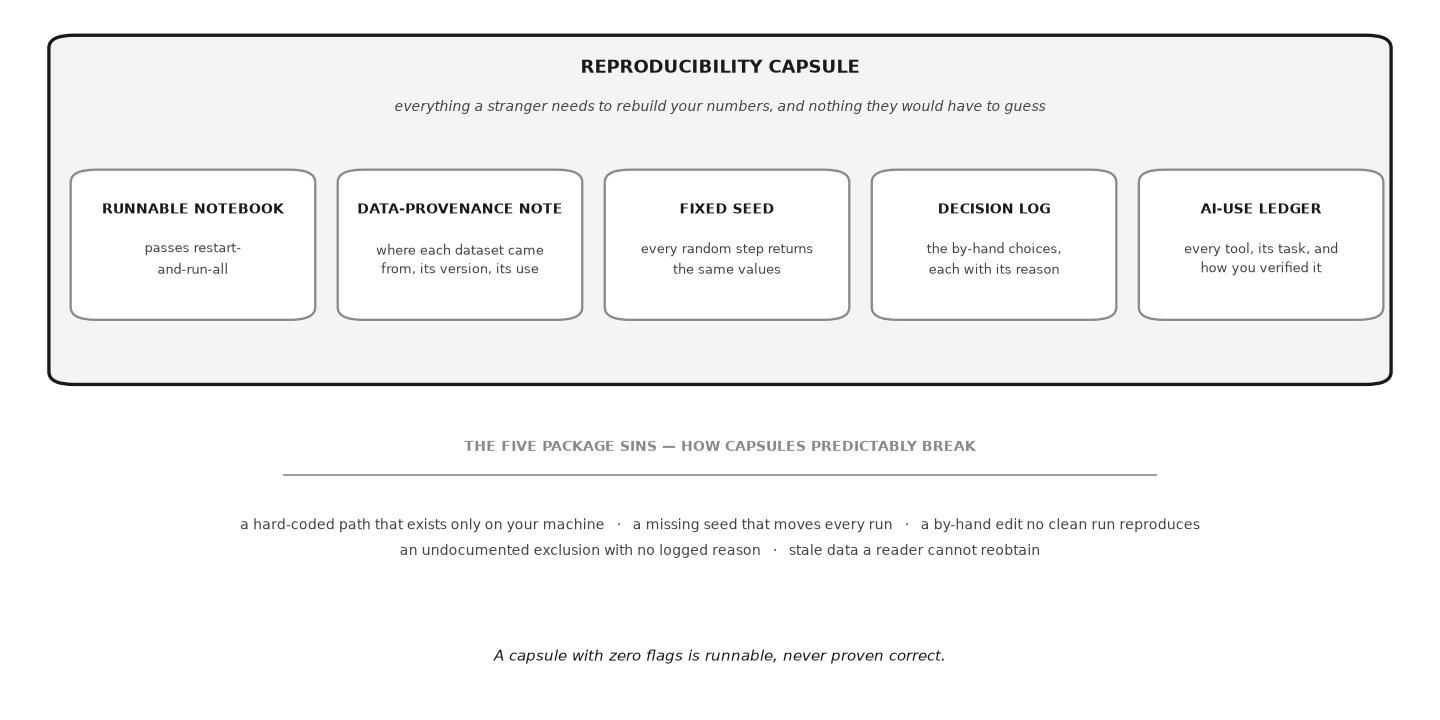
Zero flags means runnable, never proven correct
Chapter 37 · The concept
The scan gets you to the starting line. A person who reruns you cold is the race.
- A clean audit says the code executes. It says nothing about whether the numbers are right.
- The honesty check is the one the auditor cannot do for you.
Twelve counties of turnout, shipped two ways
Chapter 37 · A worked example
- You collected precinct-level turnout for twelve counties in one state’s midterm election.
- Your headline: the share of precincts where turnout fell below 40%.
- Same analysis, same headline, two very different folders.
The sinful capsule commits all five, and every one breaks the rerun
Chapter 37 · A worked example
- Loads
turnout_clean.csvfrom your own Desktop, a file only your laptop has. - Bootstraps the interval with no seed, so the interval shifts on every run.
- Patches one duplicated precinct name by hand, in a cell no clean run repeats.
- Silently drops every precinct with a missing registered-voter count, with no note on why.
- Data downloaded “sometime last spring,” before the count was certified, no version recorded.
The clean capsule fixes each sin where a stranger can see it
Chapter 37 · A worked example
- Loads the certified file through its public URL, with source, download date and terms of use.
- Fixes
SEED = 464before the bootstrap. - Records the one relabel in the decision log, with its reason.
- Keeps the missing-registration precincts, or drops them by a logged, pre-declared rule.
- A stranger clears the kernel, runs top to bottom, and your share comes back.
The clean capsule can still be wrong
Chapter 37 · A worked example
- Your seed might be fixed on the wrong subset.
- Dropping the missing-registration precincts might be a bad rule, cleanly logged.
- Runnable is not correct.
- That gap is why a person exercises your capsule, not only a script.
Rerun the cell and the interval does not move
Chapter 37 · A worked example
- Every repair the sinful version did by hand happens here in code.
- Watch the duplicate-name count: removed by a line, not by an edit.
- Missing registrations are reported, not silently dropped.
- The seed is pinned, so the bootstrap interval is identical on every run.
import numpy as np, pandas as pd
SEED = 464                       # sin four, fixed: the seed is pinned
rng = np.random.default_rng(SEED)

# Twelve counties of precinct turnout, with the two data problems the sinful
# capsule handled silently: a duplicated precinct name and missing registrations.
precincts = pd.DataFrame({
    "county": np.repeat([f"county {i:02d}" for i in range(1, 13)], 25),
    "precinct": [f"P{i:04d}" for i in range(300)],
    "turnout": np.clip(rng.normal(0.44, 0.09, size=300), 0.05, 0.95),
})
precincts.loc[17, "precinct"] = precincts.loc[16, "precinct"]     # the duplicate
precincts.loc[rng.choice(300, 14, replace=False), "turnout"] = np.nan

deduped = precincts.drop_duplicates("precinct")
missing = deduped.turnout.isna().sum()
below = (deduped.turnout < 0.40).sum() / deduped.turnout.notna().sum()

boot = [(rng.choice(deduped.turnout.dropna(), deduped.turnout.notna().sum())
         < 0.40).mean() for _ in range(2000)]
lo, hi = np.percentile(boot, [2.5, 97.5])

print(f"precincts loaded         : {len(precincts)}")
print(f"duplicate names removed  : {len(precincts) - len(deduped)}")
print(f"registrations missing    : {missing} (reported, not silently dropped)")
print(f"share below 40% turnout  : {below*100:.1f}% [{lo*100:.1f}%, {hi*100:.1f}%]")
print("\nrerun this cell: the interval does not move, because the seed is")
print("pinned and every repair above happens in code a clean run repeats")An AI failure case
Chapter 37
Where the tool failed
You paste your notebook into your AI and ask, “will this run cold and produce my low-turnout share?” It walks through every cell and answers, with total confidence, “Yes, this runs top to bottom cleanly and returns your headline number.” It sounds like a green check. It is not. The AI never executed anything. It read the code and narrated it. Cell 3 loads ~/Desktop/turnout_clean.csv, a path only your laptop has, and the fluent walkthrough described reading that file as if it were sitting there.
How it failed
Chapter 37 · An AI failure case
- You catch it the only way that counts: you actually run restart-and-run-all on a fresh kernel, ideally in Colab on a machine that is not yours.
- The
FileNotFoundErrorappears on cell 3 in seconds. - A narrated run is not a run.
- You verify the notebook by executing it, not by reading a paragraph about executing it.
Do not delegate
Chapter 37
This stays yours
You decide what goes in the capsule and whether the sentence “this reproduces” is honest. The tool can list gaps and pin versions, but it cannot record your true data provenance, judge whether an exclusion’s logged reason is a good reason, or certify that your analysis is correct rather than merely runnable. The name on the folder, and the claim that a stranger can trust it, are yours.
It is your turn
Chapter 37 · Your move
- Assemble the five parts for your own project: the runnable notebook, the data-provenance note, the fixed seed, the decision log, and your AI-use ledger.
- Run the chapter’s audit on your own key lines and fix what it flags, starting with the sin you were most tempted to leave alone.
- Write the README a stranger reads first: what the project asks, what the headline number is, which file produces it, and in what order to run things.
- Rerun it cold in a second environment, a clean Colab session or a machine that is not yours, and check the headline returns within rounding.
- Write one honest sentence about the limit of all this: your capsule is runnable, which is not the same as correct, and name the choice inside it you would most want a reviewer to question.
- Log the packaging round in your AI Research Ledger, and verify at least one output with a named method from the Verification Guide.
Work it in the companion notebook with Chapter 37 open beside it. Log every delegation in your AI Research Ledger.
Milestone 11: Your reproducible package
Studio 11 closes here
What the lessons handed you becomes one artifact you can defend.
What this milestone produces
Milestone 11
The artifact
What this milestone produces. An independent cold-run record and a reusable research package. Working alone, the record is a clean-environment rerun labeled “solo proxy; external cold run pending” — the label, and the honesty it enforces, are part of the artifact.
What you bring
Milestone 11 · Check before you start
- Lesson 36 — Replication and Reproduction: your cold reproduction record: every number re-run from the top, one undisclosed choice varied, and missingness classified before any filling.
- Lesson 37 — Open and Reusable Research Packages: your research capsule: the runnable notebook, the data-provenance note with its terms of use, the fixed seed, the decision log, your AI-use ledger, the environment record, the README, and a cold rerun in a second environment.
The practice
Milestone 11 · In the studio
- Assemble the draft package first: data or its access route, code, environment, documentation, and licence.
- Run your own package cold, from a clean environment, following only your written instructions.
- Then the external test: have someone else run it without your help, and log every place they had to ask you a question. Working alone? Rerun it yourself after a real break, instructions only, and label the record ‘solo proxy; external cold run pending’ — a proxy never becomes a claim of independent reproduction.
- Fix what the runs exposed — every question asked is a missing line in your documentation — and freeze the final manifest with its date.
The four rails, here
Milestone 11 · Every studio, these four
Ethics, permissions, and data exposure
What can be shared is set by your permissions, and the package says so explicitly.
Evidence, provenance, and reproducibility
Reproduction is the evidence rail’s final test.
AI activity, verification, and human decisions
An assistant can generate documentation; only a cold human run can validate it.
Uncertainty, claim boundary, and revision history
Reproduce the uncertainty statement, not only the point estimate.
A version, not a pass
Milestone 11
How the record works
Your milestone artifact is a dated, numbered version with the reason for the version attached. When later evidence changes it, you write the next version rather than editing the last one, because the sequence of changes is itself part of your research record.
The one rule
AI is your arm and your research assistant, not your brain.
AI can review AI, and a second model is a real auditor of the first. The last decision is always human.

EDR|AI · Studio 11 — Reproduce and package